
Bodyweight Calisthenics Progression Sheet Template
Mastering your fitness journey requires a structured bodyweight calisthenics progression sheet to track strength training gains effectively. By maintaining a detailed workout log, you ensure consistent progressive overload, which is vital for muscle building and skill acquisition. This systematic approach allows athletes to monitor reps, sets, and form improvements across various bodyweight exercises. Precise fitness tracking transforms effort into measurable performance gains, leading to total bodyweight mastery and peak physical conditioning. Please check the already made variation of templates below.
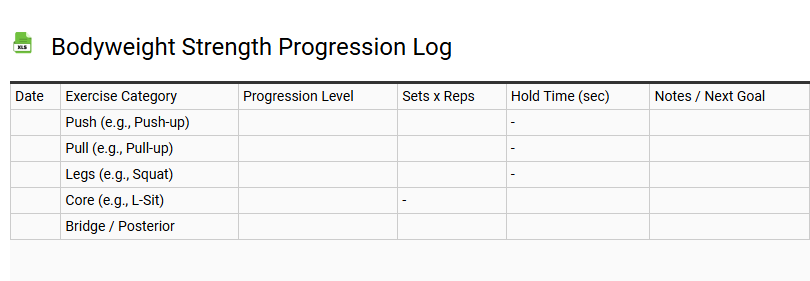
Bodyweight Strength Progression Log
💾 Bodyweight Strength Progression Log .xls
A bodyweight strength progression log is a vital tool for mastering calisthenics and functional movement. This template utilizes progressive overload principles to track essential performance metrics, including sets, repetitions, and time under tension. By documenting specific exercise variations and technical cues, athletes can ensure consistent strength gains and structural adaptations without traditional weights.
Monitoring training volume and intensity allows for precise adjustments in workout frequency and recovery cycles, which are crucial for muscle hypertrophy and neurological efficiency. This systematic approach helps identify plateaus early, enabling users to modify leverage or increase resistance through advanced progressions. Maintaining a detailed fitness journal fosters accountability and provides a clear roadmap toward achieving bodyweight mastery. Whether focusing on endurance or explosive power, recording every session ensures long-term athletic development and peak physical conditioning through data-driven training adjustments.
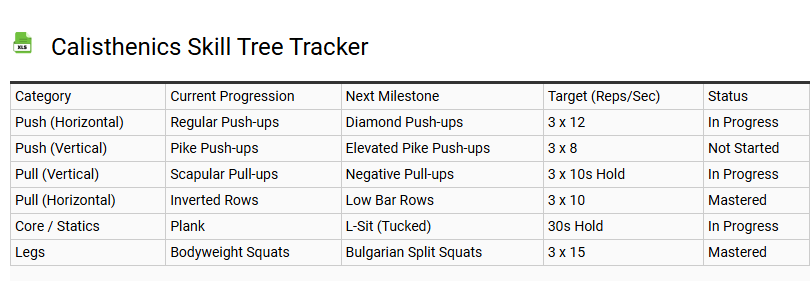
Calisthenics Skill Tree Tracker
💾 Calisthenics Skill Tree Tracker .xls
A calisthenics skill tree tracker serves as a comprehensive visual roadmap for mastering complex bodyweight exercises through systematic progressive overload. By deconstructing elite movements such as the planche, front lever, and muscle-up into logical progressions, athletes can prioritize specific movement patterns and skill acquisition. This template effectively monitors rep ranges, set volume, and static hold durations to ensure consistent neurological adaptation and muscle hypertrophy.
Utilizing this structured framework enhances functional strength and core stability while preventing training plateaus. Tracking explosive power and isometric tension allows for better management of strength training intensity and recovery cycles. Whether you are refining handstand balance or increasing weighted dip capacity, this tracker acts as a vital fitness goal dashboard, ensuring peak performance and technical precision in your street workout journey.
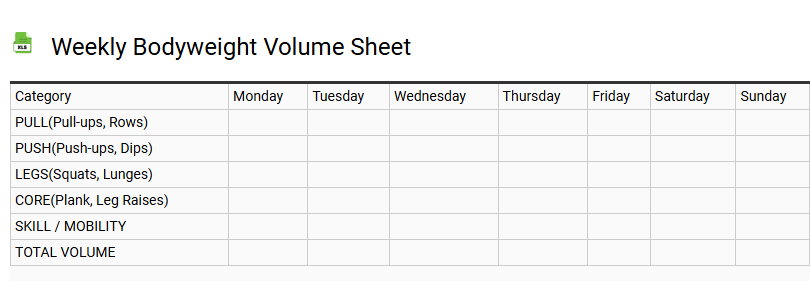
Weekly Bodyweight Volume Sheet
💾 Weekly Bodyweight Volume Sheet .xls
A Weekly Bodyweight Volume Sheet serves as a vital tool for tracking resistance training progress and ensuring muscle hypertrophy through systematic data entry. By monitoring total sets, reps, and frequency across various calisthenics movements, athletes can effectively implement progressive overload strategies. This workout log focuses on volume accumulation, allowing for precise fitness monitoring and adjustments to exercise intensity.
Utilizing a structured template helps visualize strength gains over time, identifying plateaus while optimizing recovery periods. Whether targeting pull-ups, push-ups, or squats, documenting every session ensures consistent stimulus for muscular adaptations. Integrating this tracking system fosters accountability and precision in bodyweight routines, bridging the gap between raw effort and measurable results. By analyzing weekly totals, users can refine their training load to achieve peak performance and body composition goals within a balanced fitness program.
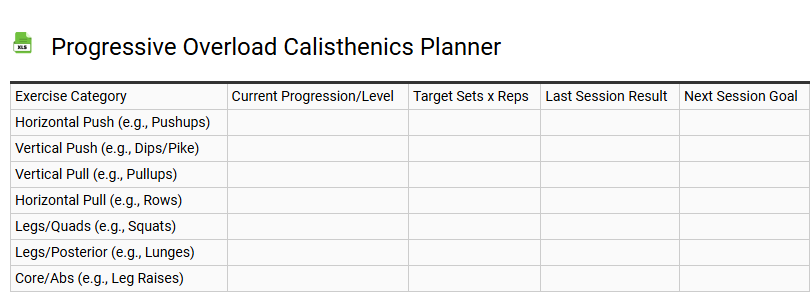
Progressive Overload Calisthenics Planner
💾 Progressive Overload Calisthenics Planner .xls
A progressive overload calisthenics planner provides the structural framework necessary for consistent bodyweight strength gains and muscle hypertrophy. By tracking training variables such as rep ranges, total volume, and rest intervals, this template ensures systematic linear progression. Users can record workout logs to monitor mechanical tension and adjust leverage to increase difficulty without external weights.
Incorporating periodization helps athletes overcome performance plateaus while optimizing recovery periods. This fitness tracker focuses on functional fitness movements, including pull-ups, dips, and push-up variations. By manipulating tempo and intensity, the planner facilitates the metabolic stress required for muscle growth. Documenting every training session allows for precise scaling of exercises, ensuring that form remains a priority as resistance increases within your bodyweight training regimen.
Bodyweight Exercise Library and Log
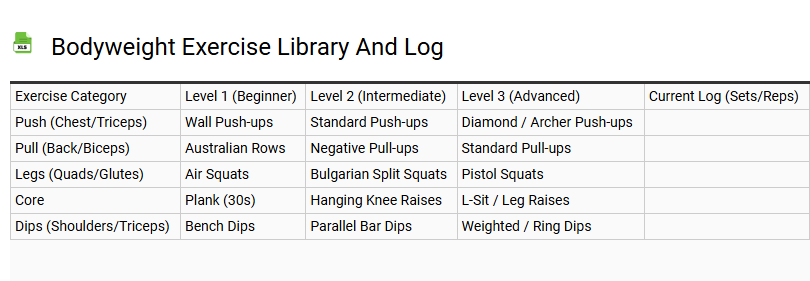
💾 Bodyweight Exercise Library and Log .xls
This bodyweight exercise library serves as a robust digital hub for mastering calisthenics and functional movement patterns. By categorizing essential exercises like pull-ups, squats, and dips, this template facilitates structured progressive overload without the need for external gym equipment. The integrated workout log allows users to meticulously track repetitions, sets, and rest duration, providing a clear visual of performance metrics over time.
Optimizing for muscle hypertrophy and cardiovascular endurance, this framework simplifies the process of monitoring resistance training volume. Users can document every training session, ensuring consistent gains in strength and mobility. Whether focusing on core stability or explosive power, this comprehensive fitness tracking resource ensures that every gravity-based movement contributes to long-term athletic development. Use this log to refine form, establish personal records, and build a customized fitness regimen focused on functional strength.
Advanced Calisthenics Movement Tracker
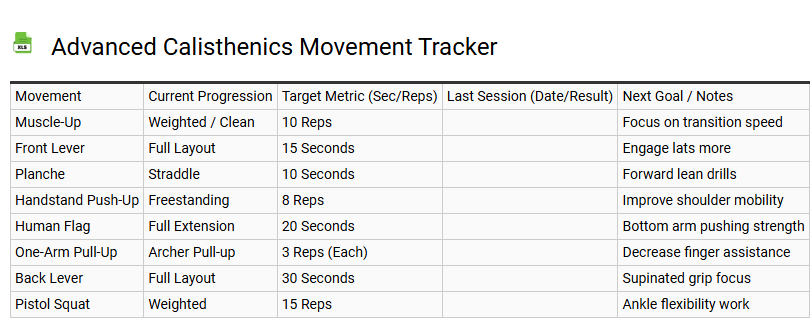
💾 Advanced Calisthenics Movement Tracker .xls
This advanced calisthenics movement tracker provides a systematic framework for monitoring elite bodyweight strength progression. By documenting complex biomechanics, athletes can optimize their kinetic chain for high-level skill acquisition, such as planches, front levers, and muscle-ups.
This digital log emphasizes precise metrics, including time under tension, eccentric control, and specific joint angles, to ensure consistent progressive overload. Users can track set volume and rest intervals to fine-tune neuromuscular adaptations and stimulate muscle hypertrophy effectively.
Whether mastering explosive plyometric power or refining static isometric holds, this tool analyzes mechanical advantage and recovery cycles to prevent overtraining. Enhance training efficiency by recording concentric intensity and technical execution across diverse compound movements. Utilizing this data-driven approach allows for granular adjustments in scaling and leverage, facilitating continuous performance gains in professional gymnastics and street workout disciplines.
Beginner Bodyweight Routine Template
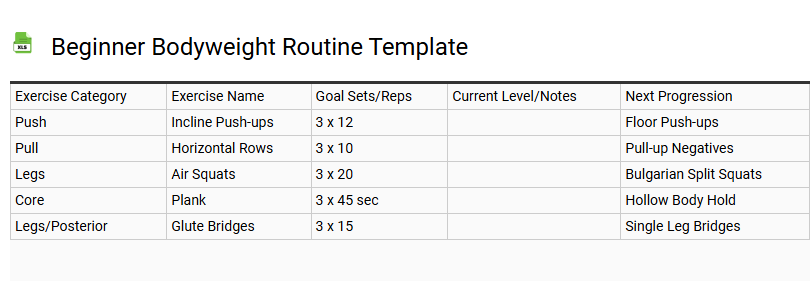
💾 Beginner Bodyweight Routine Template .xls
This beginner bodyweight routine template serves as a foundational blueprint for those starting their calisthenics journey. Focused on functional fitness, the program prioritizes compound movements to build total-body strength without specialized gym equipment. By incorporating push-ups, bodyweight squats, and planks, practitioners develop essential muscle endurance and core stability.
To ensure steady progression, each session should follow a structured format of sets and repetitions tailored to individual capacity. Key components include:
- Dynamic warm-ups to prime joints and ligaments.
- Primary strength training exercises targeting major muscle groups.
- Adequate recovery periods between circuits to optimize performance.
- Consistent form correction to prevent injury.
This scalable home workout approach allows for seamless transitions into advanced variations, making it a sustainable fitness plan for long-term physical conditioning and metabolic health.
Muscle-Up Progression Chart
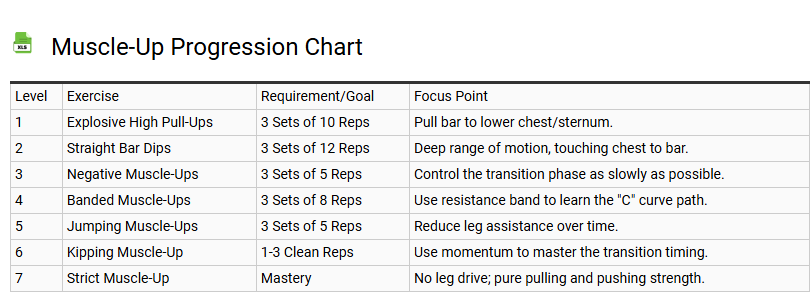
💾 Muscle-Up Progression Chart .xls
A structured approach to mastering the muscle-up requires a strategic breakdown of upper body pulling and pushing mechanics. This template organizes training into logical phases, ensuring the body adapts to the high demands of the transition phase. By tracking specific milestones, athletes can identify gaps in explosive power or false grip stability.
- Foundational Strength: Focus on high-volume pull-ups and deep dips to build the necessary muscular base.
- Explosive Development: Prioritize chest-to-bar repetitions to generate the upward momentum required for the turnover.
- The Transition: Utilize negative muscle-ups and banded assists to bridge the gap between the pull and the push.
- Full Integration: Combine all elements into a fluid motion, emphasizing technical precision above the bar or rings.
Using this systematic layout helps prevent injury while promoting consistent gains in functional strength and technical proficiency throughout the movement's evolution.
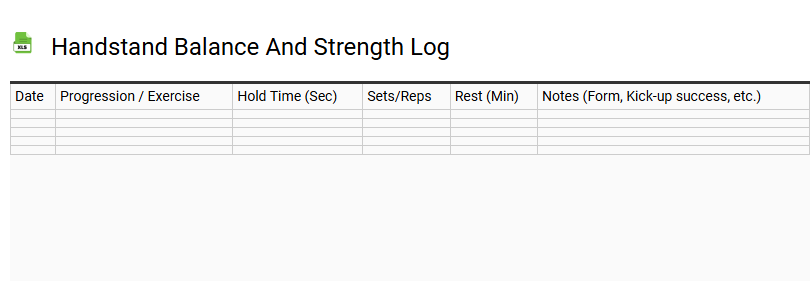
Handstand Balance and Strength Log
💾 Handstand Balance and Strength Log .xls
Optimizing your handstand balance and gymnastic strength requires a structured approach to tracking progress. Utilizing a specialized training log allows practitioners to monitor critical metrics such as hold duration, core stability, and shoulder mobility. By documenting daily handstand drills, including wall walks and freestanding attempts, you ensure consistent progressive overload essential for skill acquisition.
A comprehensive log should detail wrist flexibility routines, hollow body positioning, and scapular strength exercises. Focus on recording specific variables to enhance your proprioception and alignment:
- Kick-up consistency and entry techniques.
- Handstand push-up repetitions for overhead pressing power.
- Total volume of isostatic holds to build endurance.
Systematic data entry helps identify plateaus in bodyweight balance, ensuring your calisthenics journey remains focused on functional strength and vertical stability.
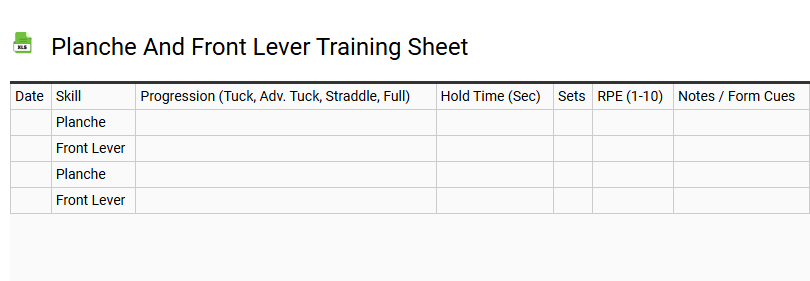
Planche and Front Lever Training Sheet
💾 Planche and Front Lever Training Sheet .xls
This specialized calisthenics training template is engineered to accelerate mastery of elite static holds. Designed for tracking planche and front lever progressions, this log prioritizes straight-arm strength and scapular stability. Users can systematically document isometric hold times, volume, and intensity across various difficulty levels, from tuck variations to full layouts. By monitoring scapular protraction and retraction metrics, athletes ensure technical precision and injury prevention.
The structured layout facilitates progressive overload by recording sets, reps, and RPE for specific accessory movements like pseudo-planche push-ups and dragon flags. This workout sheet serves as a comprehensive performance tracker, allowing for data-driven adjustments to hypertrophy and neuromuscular adaptation phases. Optimize your bodyweight strength journey by analyzing time under tension and recovery cycles within this streamlined digital training log.
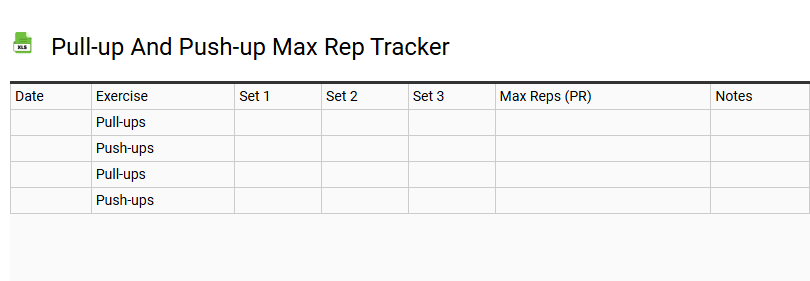
Pull-up and Push-up Max Rep Tracker
💾 Pull-up and Push-up Max Rep Tracker .xls
Monitoring physical strength gains requires a structured approach to data collection. This Pull-up and Push-up Max Rep Tracker serves as a dedicated log for capturing peak performance in bodyweight training. By documenting the highest number of successful repetitions achieved in a single set, individuals can effectively visualize their progress and identify physiological plateaus.
The layout typically includes specific data points to ensure accuracy:
- Date of Attempt: Tracking the timeline of strength evolution.
- Exercise Type: Distinguishing between vertical pulling and horizontal pushing movements.
- Repetition Count: Recording the total volume completed with proper form.
- Rest Intervals: Noting recovery periods between maximal efforts.
Maintaining this record fosters accountability and provides the necessary insights to adjust training intensity. Consistently updating these benchmarks allows for the precise calculation of volume increases, ensuring steady improvement in muscular endurance and upper body power.
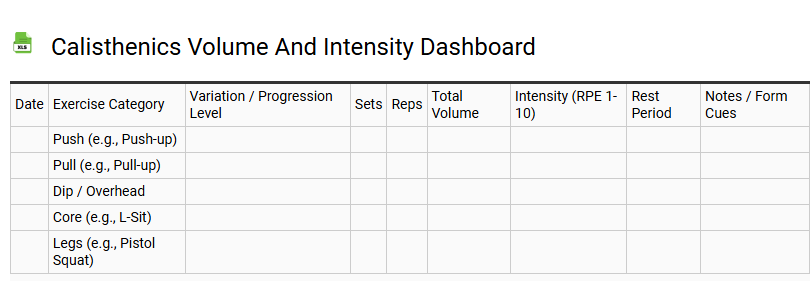
Calisthenics Volume and Intensity Dashboard
💾 Calisthenics Volume and Intensity Dashboard .xls
Optimize your bodyweight training with this comprehensive calisthenics volume and intensity dashboard. This specialized template enables athletes to monitor progressive overload through detailed performance tracking of key metrics. By calculating total workload and relative intensity, you can effectively balance hypertrophy goals with neuromuscular strength gains. The dashboard visualizes cumulative repetitions, set density, and RPE (Rate of Perceived Exertion) to prevent overtraining and systemic fatigue. Track your journey from basic pull-ups to advanced static holds and isometrics using data-driven insights. Designed for serious practitioners, this tool simplifies workout programming by highlighting trends in training frequency and exercise volume. Maintain peak performance by analyzing weekly tonnage and adjusting recovery intervals based on real-time feedback. Master your bodyweight mastery journey with precise data visualization and consistent progress monitoring.
Bodyweight Repetition PR Tracker
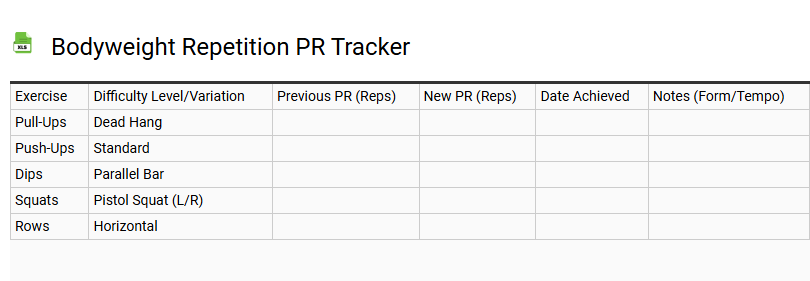
💾 Bodyweight Repetition PR Tracker .xls
A Bodyweight Repetition PR Tracker is an essential tool for athletes utilizing calisthenics to achieve progressive overload. By documenting your personal records in high-tension movements like pull-ups, push-ups, and dips, you gain data-driven insights into your functional strength and muscular endurance.
This template facilitates precise workout logging, helping you monitor training volume and hypertrophy indicators over time. Consistent tracking offers several advantages for your fitness goals:
- Visualizing performance metrics to maintain long-term motivation.
- Identifying plateaus within strength training cycles.
- Optimizing recovery and intensity for peak athletic performance.
Quantifying your repetition maximum ensures every session contributes to your bodyweight exercise mastery. By analyzing these performance gains, you can adjust your training variables to ensure steady, measurable growth in your physical capabilities.
Skill-Specific Progression Matrix
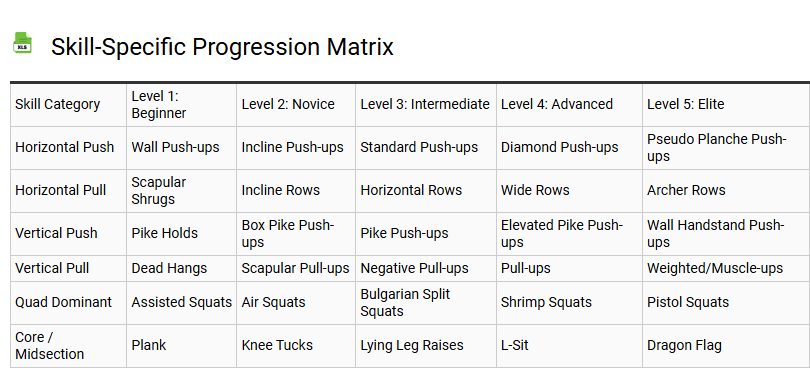
💾 Skill-Specific Progression Matrix .xls
A skill-specific progression matrix serves as a comprehensive competency framework designed to map professional development across distinct proficiency levels. This strategic career pathing tool allows organizations to define transparent performance benchmarks for both technical expertise and soft skills, ensuring a standardized approach to talent management.
By implementing this growth roadmap, leadership can effectively:
- Identify skill gaps to inform targeted learning and development initiatives.
- Streamline employee assessments using objective, measurable criteria.
- Facilitate succession planning by identifying high-potential capabilities.
- Enhance workforce planning and organizational development.
Ultimately, a well-structured matrix bridges the gap between current job roles and future leadership requirements, fostering a culture of continuous improvement and operational excellence through clear professional advancement milestones.
Weighted Calisthenics Strength Log
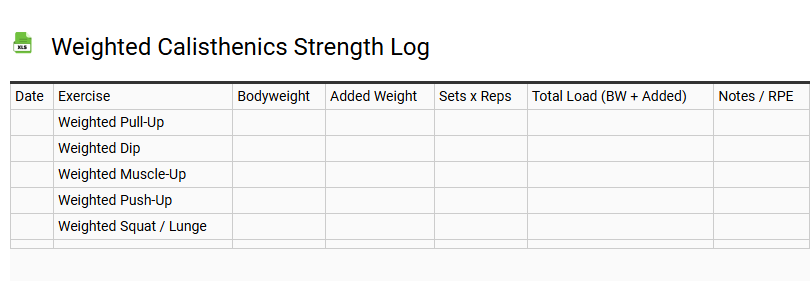
💾 Weighted Calisthenics Strength Log .xls
A comprehensive weighted calisthenics strength log is essential for tracking progressive overload in fundamental compound movements. By recording the external resistance added to exercises like weighted pull-ups and dips, athletes can precisely monitor muscle hypertrophy and neuromuscular adaptation.
A structured template focuses on critical training variables to ensure peak performance, including:
- Load intensity (kilograms or pounds added to a dip belt)
- Total volume calculated through sets and rep ranges
- Rest intervals for central nervous system recovery
- Tempo control and range of motion notes
Utilizing a dedicated workout journal helps identify performance plateaus and ensures consistent strength gains. Documenting every increment of external load is vital for long-term progression in bodyweight strength training, transforming basic movements into high-intensity resistance exercises through data-driven recovery management.
Isometric Hold Duration Tracker
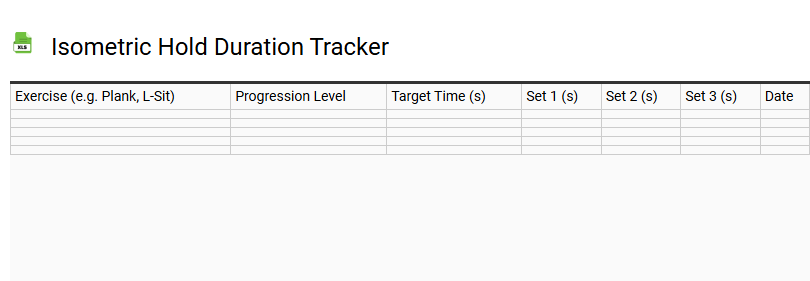
💾 Isometric Hold Duration Tracker .xls
An Isometric Hold Duration Tracker is an essential tool for athletes focusing on static strength and time under tension (TUT). By documenting precise muscular endurance metrics, users can effectively implement progressive overload to bypass training plateaus. This template streamlines the recording of muscle activation levels during exercises like planks, wall sits, and l-sits, where joint angles remain constant.
Utilizing a structured fitness log allows for the analysis of muscular fatigue thresholds and recovery patterns. Key data points often include:
- Baseline duration to establish initial performance benchmarks.
- Target hold times for incremental hypertrophy goals.
- Grip strength and core stability correlations.
- Rest intervals to monitor central nervous system recovery.
Integrating these performance analytics into your routine ensures objective tracking of functional strength gains and enhanced mind-muscle connection across all isometric training disciplines.
Calisthenics Form and Technique Checklist
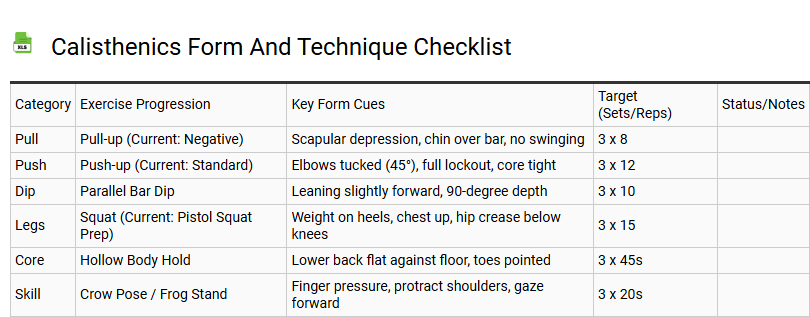
💾 Calisthenics Form and Technique Checklist .xls
A comprehensive calisthenics form checklist ensures peak neuromuscular efficiency and safety during bodyweight training. To master compound movements like pull-ups, muscle-ups, or dips, athletes must prioritize joint alignment and structural integrity. This template emphasizes scapular retraction, posterior pelvic tilt, and consistent core engagement to maintain a rigid kinetic chain.
Implementing a technique-first approach facilitates steady progressive overload without compromising musculoskeletal health. Essential evaluation points include:
- Full Range of Motion (ROM): Avoiding partial repetitions to maximize muscle fiber recruitment.
- Eccentric Control: Managing the lowering phase to enhance time under tension.
- Hollow Body Posture: Eliminating lumbar compensation for total-body tension.
- Isometric Stability: Ensuring stillness during static holds and levers.
Utilizing these parameters optimizes muscle activation, fostering functional strength and athletic longevity through disciplined bodyweight mechanics and refined motor patterns.
Daily Bodyweight AMRAP Log
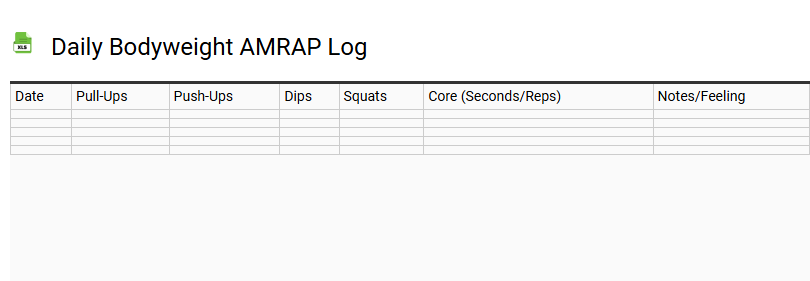
💾 Daily Bodyweight AMRAP Log .xls
Utilizing a Daily Bodyweight AMRAP Log is essential for athletes focusing on high-intensity interval training and calisthenics. This tracking template records total repetitions and completed cycles within a specific time-cap, ensuring consistent progressive overload. By documenting metabolic conditioning sessions, you can accurately measure work capacity and muscular endurance over time.
- Track functional fitness movements like air squats, lunges, and planks.
- Monitor performance metrics to visualize fitness gains.
- Optimize training volume for improved cardiovascular stamina.
This workout log serves as a data-driven roadmap for bodyweight strength and conditioning. Consistent entries allow for adjustments in intensity, helping you shatter plateaus and achieve peak physical performance through structured AMRAP (As Many Rounds As Possible) cycles and circuit training protocols.
Bodyweight Workout Frequency Calendar
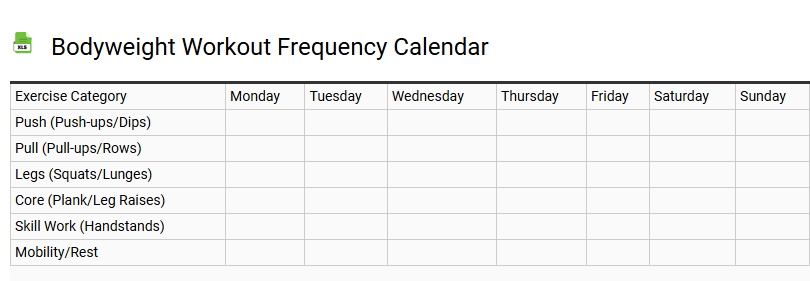
💾 Bodyweight Workout Frequency Calendar .xls
Utilizing a structured bodyweight workout frequency calendar is essential for managing progressive overload and ensuring adequate recovery periods. This template helps practitioners track calisthenics sessions, balancing training volume with systemic fatigue to promote muscle hypertrophy and neuromuscular adaptation.
By documenting your exercise routine, you can visualize strength training consistency and strategically place rest days for optimal cellular repair. A well-organized workout schedule prevents overtraining while maximizing physical fitness gains. Whether your goal is functional strength or metabolic conditioning, monitoring the frequency of movements like push-ups, pull-ups, and squats ensures a balanced approach to resistance training. Use this data-driven log to harmonize your fitness journey and achieve long-term physiological adaptations through disciplined, body-weight-focused movements and optimized frequency.
Core and Abdominal Strength Progression Sheet
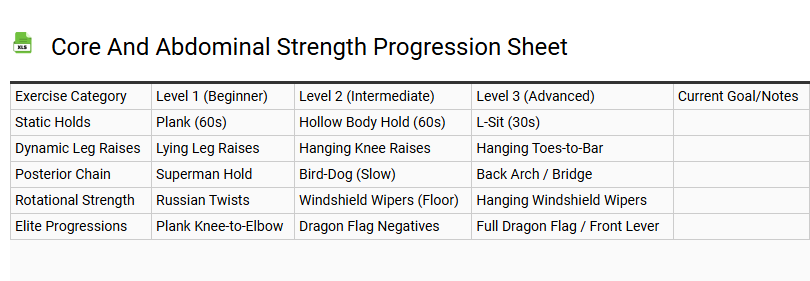
💾 Core and Abdominal Strength Progression Sheet .xls
This core and abdominal strength progression sheet serves as a vital workout log for monitoring functional stability and trunk control. By utilizing a structured training template, athletes can systematically track metrics such as sets, repetitions, and isometric hold durations. Exercises targeting the rectus abdominis, obliques, and transverse abdominis are documented to ensure the progressive overload principle is applied effectively.
Maintaining a precise performance record facilitates the development of muscular endurance and spinal stability. This data-driven approach to core conditioning allows for the optimization of exercise volume and frequency, helping to overcome plateaus in athletic performance. Whether focusing on dynamic movements or static holds, consistent documentation of core stability routines promotes postural alignment and long-term injury prevention through evidence-based training adjustments.
Utilizing a structured bodyweight calisthenics progression sheet is essential for monitoring progressive overload and achieving movement mastery. This template functions as a comprehensive training log, allowing athletes to track reps, sets, and specific exercise variations accurately. By documenting your daily workout routine, you can visualize strength gains and reach fitness goals efficiently. Implementing this fitness tracker ensures consistent performance improvements, providing the data-driven insights necessary to master advanced skills and optimize your overall physical transformation journey.