
Exercise Substitution Reference Guide Template
Establishing a structured exercise substitution reference guide is vital for maintaining training consistency when equipment availability or physical limitations change. This template allows you to identify equivalent movements based on specific muscle groups, biomechanical patterns, and joint actions. By focusing on primary movers, you can seamlessly swap variations without compromising your fitness goals or total training volume. A reliable framework ensures optimal progression whether you are working around injuries or a limited gym setup. Check out our already made variation of templates below.
Muscle Group Movement Matrix
💾 Muscle Group Movement Matrix .xls
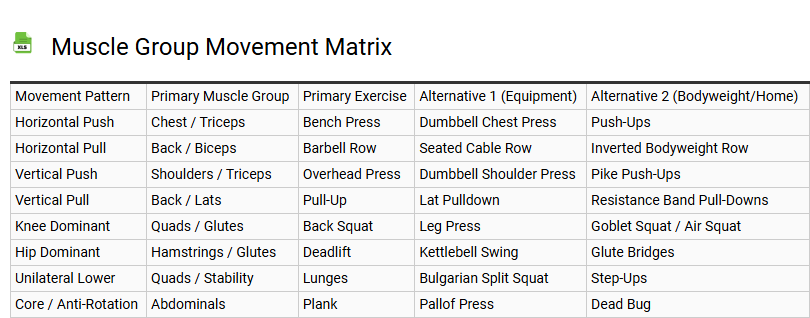
A Muscle Group Movement Matrix serves as a comprehensive framework for mapping resistance training exercises against anatomical planes and physiological roles. This strategic template categorizes movements by identifying primary movers (agonists), antagonists, and synergists within the kinetic chain. By organizing data across the sagittal, frontal, and transverse planes, fitness professionals ensure balanced structural development and hypertrophy.
The matrix evaluates the interplay between compound movements and isolation exercises, highlighting how specific motor patterns recruit muscle fibers. Utilizing this tool optimizes biomechanics, corrects muscular imbalances, and enhances neuromuscular adaptation. It acts as a blueprint for functional training, ensuring every major muscle group-from the posterior chain to core stabilizers-is targeted through diverse stimuli. This systematic approach streamlines workout architecture, providing a holistic view of force production and joint stability for peak physiological performance.
Alternative Exercise Library
💾 Alternative Exercise Library .xls
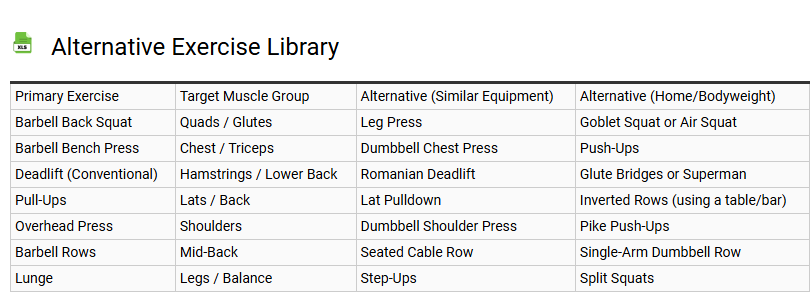
This Alternative Exercise Library serves as a dynamic resource for workout modifications and fitness variations. By focusing on fundamental movement patterns, users can easily identify equipment substitutions or home gym alternatives when traditional gear is unavailable. Each entry is strategically categorized by primary muscle groups to ensure targeted strength training and consistent progressive overload.
Whether you require low-impact options for injury prevention or bodyweight progressions to enhance mobility, this database prioritizes biomechanical efficiency. These replacement exercises allow for seamless exercise selection, ensuring your training volume remains high while adapting to your specific environment. Perfect for athletes seeking functional swaps, our library bridges the gap between limited resources and peak physical performance through versatile training adaptations and evidence-based movement regressions.
Equipment Availability Swap Guide
💾 Equipment Availability Swap Guide .xls
This Equipment Availability Swap Guide serves as a comprehensive framework for optimizing resource allocation and asset management. By implementing structured replacement protocols, organizations ensure maximum operational uptime while minimizing disruption during scheduled maintenance or unexpected hardware failures. Effective inventory tracking identifies available machinery, allowing for seamless substitution without compromising critical project timelines.
The strategic swap process focuses on logistical efficiency and conflict resolution within shared fleets. Through real-time data integration, fleet managers can monitor equipment lifecycles and trigger automated alerts for necessary rotations. Prioritizing systematic resource redistribution enhances workflow continuity, reduces costly downtime mitigation, and optimizes overall fleet utilization.
Utilizing this guide facilitates proactive decision-making, ensuring that every asset is deployed effectively across various job sites. This standardized approach to equipment substitution maintains high performance standards and supports the rigorous demands of industrial operations and supply chain management.
Bodyweight Substitution Chart
💾 Bodyweight Substitution Chart .xls
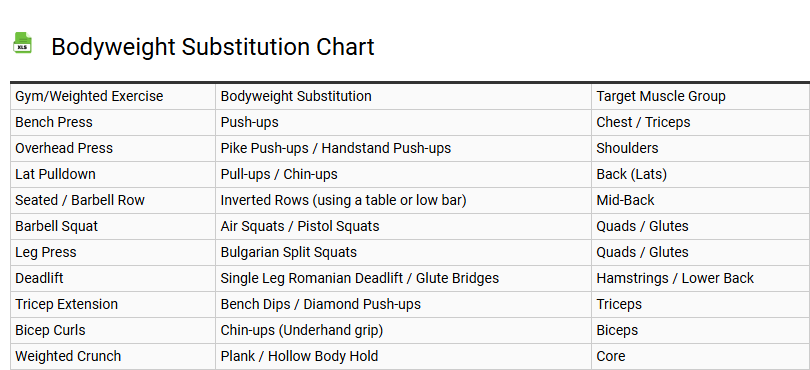
A bodyweight substitution chart serves as a vital resource for translating traditional gym lifts into effective calisthenics progressions. By categorizing exercises into fundamental movement patterns-such as the vertical pull, horizontal push, and knee-dominant transitions-this tool facilitates progressive overload without the need for external weights. It allows athletes to identify resistance training alternatives that maintain high intensity through mechanical leverage and scaling movements.
Implementing compound movements like pike push-ups for overhead presses or Bulgarian split squats for leg extensions ensures muscular hypertrophy and functional fitness. These home workout modifications are essential for maintaining a training split when equipment is limited. By focusing on gymnastic strength and unilateral exercises, a comprehensive substitution guide ensures a seamless transition between weightlifting and equipment-free training, optimizing physical performance through bodyweight mastery.
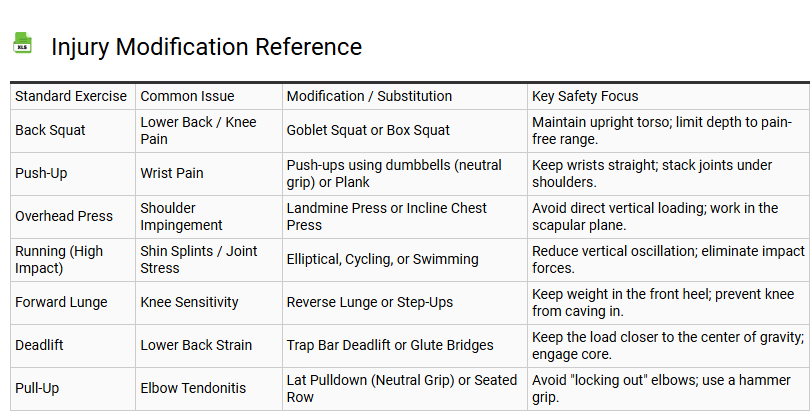
Injury Modification Reference
💾 Injury Modification Reference .xls
This reference serves as a comprehensive guide for adapting physical activity when navigating physical limitations or acute pain. It categorizes specific musculoskeletal conditions and provides evidence-based alternatives to standard movement patterns. By utilizing this framework, practitioners can identify appropriate regressions that reduce joint stress while maintaining muscle engagement.
- Movement Substitutions: Specific exercises tailored to bypass irritated tissues.
- Load Management: Strategies for adjusting intensity to prevent further aggravation.
- Range of Motion: Guidelines for shortening or altering paths of motion to ensure safety.
The objective is to facilitate continuous progress through controlled loading, ensuring that recovery aligns with functional strength goals. This structured approach allows for individualized programming, bridging the gap between rehabilitation and performance training. It prioritizes long-term joint health by offering clear, actionable substitutes for common exercises that might otherwise pose a risk during the healing process.
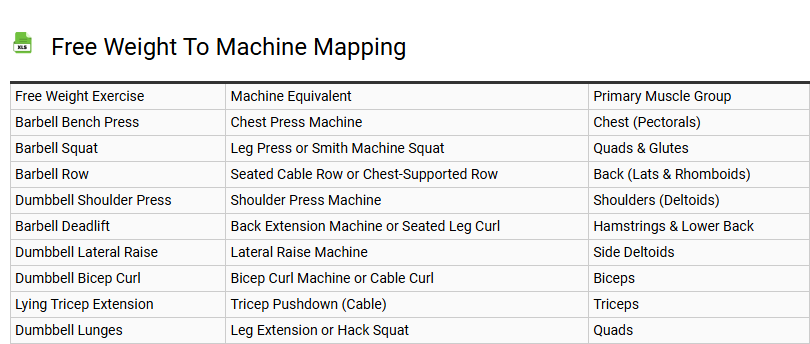
Free Weight to Machine Mapping
💾 Free Weight to Machine Mapping .xls
Developing a free weight to machine mapping strategy optimizes resistance training transitions without sacrificing muscle activation. This systematic approach translates traditional compound movements-like the barbell squat or deadlift-into mechanical equivalents such as the leg press or seated row. By identifying similar movement patterns and kinetic chains, athletes can maintain progressive overload when equipment availability is limited or when prioritizing hypertrophy through increased mechanical stability.
Effective substitutions include:
- Barbell Bench Press mapped to Chest Press Machine
- Dumbbell Overhead Press mapped to Shoulder Press Machine
- Barbell Rows mapped to Seated Cable Rows or Smith Machine variants
Utilizing these biomechanical alternatives ensures consistent mechanical tension and metabolic stress, allowing for targeted muscle fiber recruitment while reducing the stabilization demands typical of free weight exercises within a structured training program.
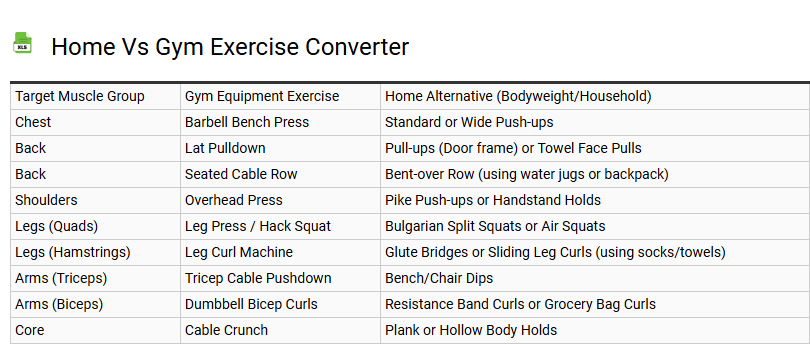
Home vs Gym Exercise Converter
💾 Home vs Gym Exercise Converter .xls
Transform your fitness routine with this Home vs Gym Exercise Converter, a specialized tool designed to bridge the gap between commercial health clubs and residential setups. Whether you lack access to a cable machine or a leg press, this resource identifies bodyweight alternatives and resistance band variations that replicate the specific biomechanics of heavy machinery.
Achieving muscle hypertrophy and progressive overload is entirely possible outside a traditional facility. Efficiently swap a barbell squat for a high-intensity goblet squat using dumbbells, or replace seated lat pulldowns with doorway pull-ups to maintain strength training volume. This converter prioritizes functional movement patterns, allowing you to adapt your workout split seamlessly. Optimize your results by utilizing equipment substitutions that ensure no muscle group is overlooked, keeping your physical progress consistent regardless of your training environment.
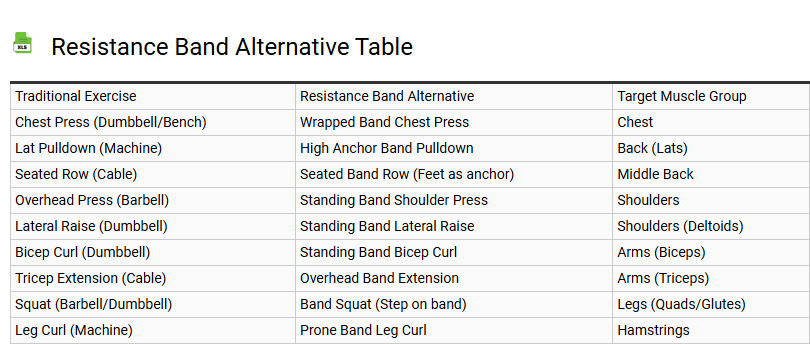
Resistance Band Alternative Table
💾 Resistance Band Alternative Table .xls
This resistance band alternative table serves as a comprehensive guide for substituting elastic tubing with traditional strength training equipment. When executing hypertrophy-focused workouts, understanding mechanical tension is vital. This matrix categorizes functional movements, mapping band exercises to cable machine pulleys, free weights, and dumbbells. Whether targeting progressive overload in a home gym or seeking versatility during travel, these substitutes maintain consistent resistance profiles. By identifying equivalent load vectors, users can seamlessly transition between resistance levels without compromising form or intensity. Utilizing this reference optimizes muscle engagement through varied force curves, ensuring your strength routine remains effective when portable equipment is unavailable. Explore diverse exercise variations to achieve peak physical conditioning using barbells or bodyweight anchors as stable alternatives to latex bands and loop sets.
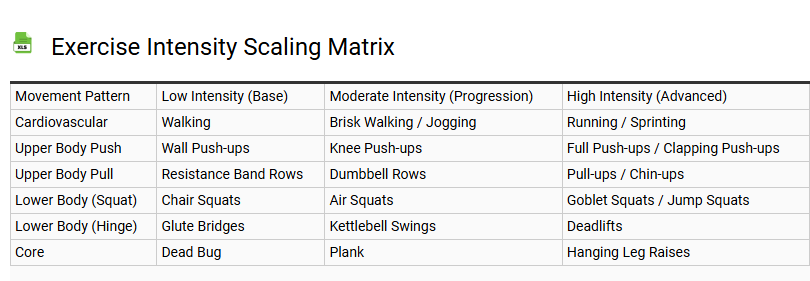
Exercise Intensity Scaling Matrix
💾 Exercise Intensity Scaling Matrix .xls
The Exercise Intensity Scaling Matrix serves as a strategic framework for implementing progressive overload across diverse fitness levels. By utilizing a structured grid, practitioners can systematically adjust training volume and physiological load based on the Rate of Perceived Exertion (RPE). This template facilitates precise workout modifications, allowing for the seamless regression or progression of complex movements to match individual capabilities.
- Optimizes metabolic demand and biomechanical stress.
- Monitors heart rate zones for targeted cardiovascular adaptations.
- Balances load, tempo, and technical complexity to ensure safety.
Integrating this matrix into your programming streamlines the transition between active recovery and high-intensity training. It provides a data-driven roadmap for managing neuromuscular fatigue, ensuring athletes achieve peak performance while maintaining movement integrity through every phase of their periodization cycle.
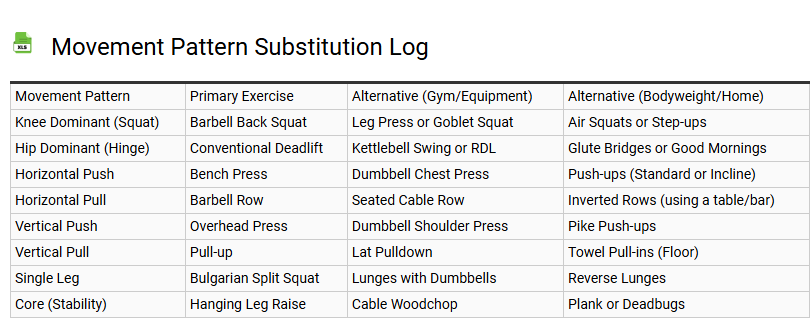
Movement Pattern Substitution Log
💾 Movement Pattern Substitution Log .xls
A Movement Pattern Substitution Log is an essential tool for maintaining training consistency when faced with equipment limitations, physical constraints, or specific performance goals. By documenting exercise variations based on biomechanical similarity, athletes can effectively swap foundational patterns-such as the squat, hinge, push, pull, and lunge-with appropriate regressions or progressions. This systematic tracking ensures that muscle recruitment and training intensity remain aligned with the original programming intent. Utilizing a log helps monitor training volume and progressive overload while prioritizing injury prevention through smart alternative exercises. Whether adjusting for joint health or gym availability, recording these functional movements preserves the integrity of a resistance training protocol. Use this template to capture the rationale behind each substitution, ensuring long-term hypertrophy and strength gains are not compromised by necessary adaptations in the weight room.
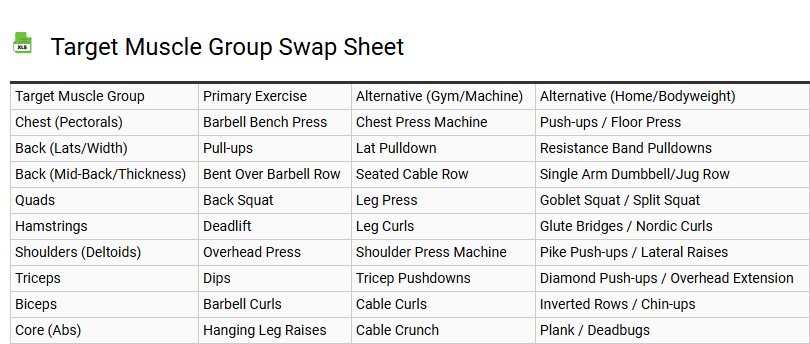
Target Muscle Group Swap Sheet
💾 Target Muscle Group Swap Sheet .xls
A target muscle group swap sheet serves as a vital resource for optimizing workout program design and ensuring consistent hypertrophy. By identifying primary movers and specific movement patterns, users can execute effective exercise substitution when faced with gym equipment limitations or physical constraints. This template focuses on biomechanics and muscle activation, allowing for seamless transitions between compound movements and isolation exercises without sacrificing training volume. Whether substituting a horizontal press or a vertical pull, maintaining progressive overload remains the priority. Utilizing this guide helps preserve mechanical tension across synergists and stabilizers, facilitating injury prevention while adhering to the original training stimulus. It is an essential tool for athletes needing alternative movements that mirror the neuromuscular demands of their primary lifts, ensuring metabolic stress and functional gains are never compromised during a session.
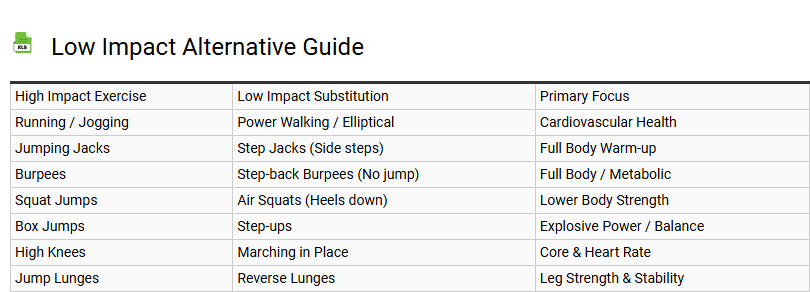
Low Impact Alternative Guide
💾 Low Impact Alternative Guide .xls
Transitioning to a low-impact lifestyle begins with identifying sustainable swaps that significantly reduce your personal carbon footprint. This guide highlights eco-friendly alternatives designed to minimize waste and promote environmental stewardship. By integrating zero-waste practices and choosing biodegradable materials, you actively support a circular economy.
Key considerations for sustainable consumption include:
- Prioritizing plastic-free options and reusable packaging.
- Selecting products with ethical sourcing and fair-trade certifications.
- Investing in durable goods to decrease resource depletion.
Embracing these green living strategies facilitates a shift toward conscious consumerism. These intentional changes help mitigate environmental degradation, ensuring long-term ecological balance while maintaining modern convenience and efficiency in your daily routine.
Compound Movement Substitution Index
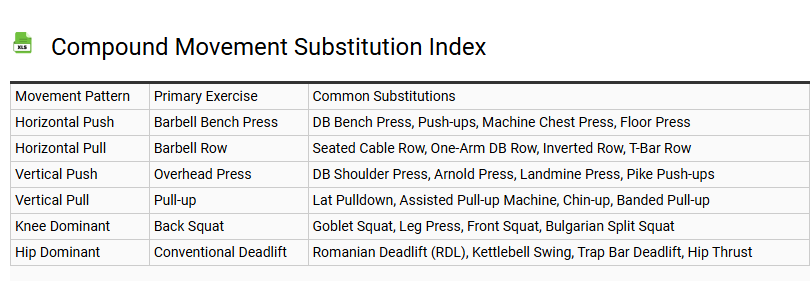
💾 Compound Movement Substitution Index .xls
Mobility and Flexibility Swaps
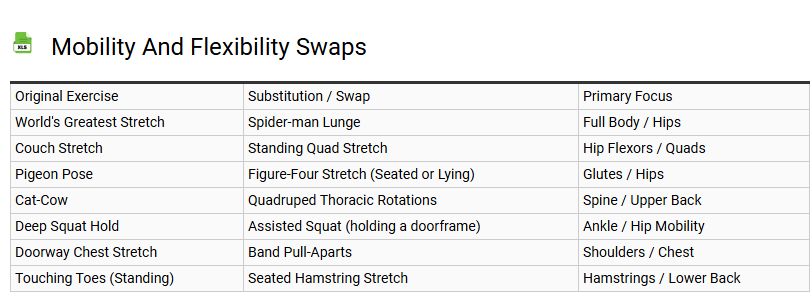
💾 Mobility and Flexibility Swaps .xls
Implementing mobility and flexibility swaps involves substituting traditional static holds with dynamic range of motion exercises to optimize joint health. These strategic movement patterns function as corrective exercises, targeting persistent muscular tension and refining biomechanics. By prioritizing active recovery, individuals can enhance functional movement capacity while significantly reducing injury risk.
- Replace passive stretching with dynamic mobilization drills.
- Swap repetitive loading for joint decoupling techniques.
- Integrate soft tissue work alongside neuromuscular activation.
Focusing on these kinesthetic adjustments ensures superior fascial elasticity and physical therapy-grade results. These swaps bridge the gap between strength training and injury prevention, fostering long-term structural integrity through controlled proprioceptive feedback and improved tissue extensibility during every workout phase.
Unilateral Movement Replacement List
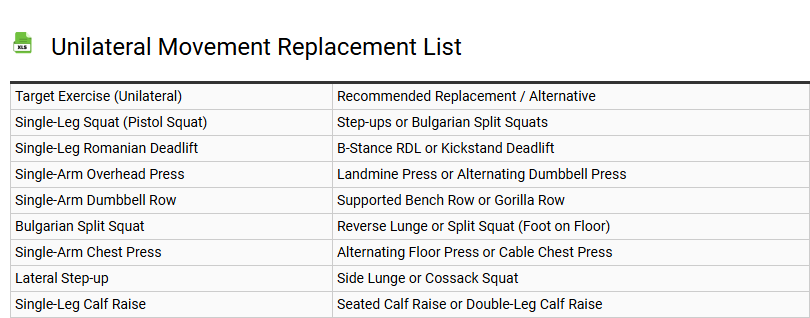
💾 Unilateral Movement Replacement List .xls
A comprehensive unilateral movement replacement list is an essential tool for correcting muscular imbalances and enhancing functional stability. By substituting standard bilateral lifts with single-limb variations, athletes can effectively address the bilateral deficit and improve neuromuscular coordination. For example, replacing a barbell back squat with a Bulgarian split squat or a single-leg press emphasizes eccentric control and core engagement.
These exercise alternatives are crucial for maintaining progressive overload when equipment is limited or during injury rehabilitation. Integrating movements like single-arm dumbbell rows or pistol squats ensures symmetrical hypertrophy and optimized joint health. Utilizing a structured substitution guide allows for seamless transitions in resistance training, promoting balanced strength distribution across the kinetic chain while maximizing range of motion and mechanical tension for superior athletic performance.
Strength Progression Substitute Tracker
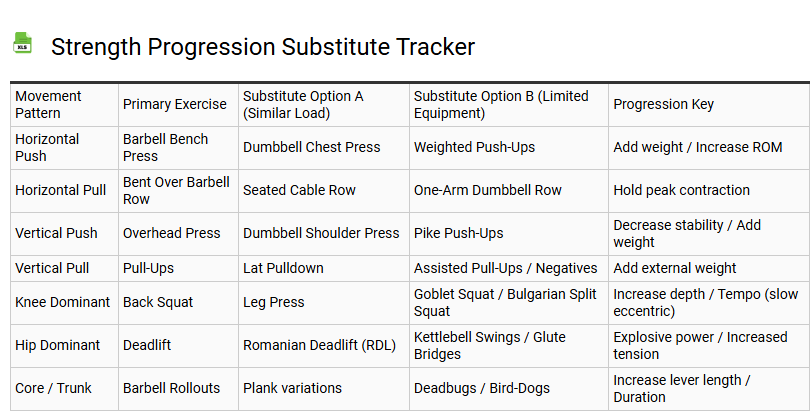
💾 Strength Progression Substitute Tracker .xls
A Strength Progression Substitute Tracker is an essential tool for maintaining progressive overload and consistent muscle growth. This template facilitates the seamless integration of exercise alternatives when specific equipment is unavailable, ensuring training volume remains optimized for hypertrophy.
By monitoring key lifting metrics, such as RPE (Rate of Perceived Exertion) and intensity, users can sustain their strength standards across various compound movements and isolation exercises. Effective tracking includes:
- Comparison of resistance training loads between primary and substitute lifts.
- Detailed analysis of gym performance trends and volume accumulation.
- Adjusting rep ranges to match original workload requirements.
Utilizing a structured workout log for substitutions prevents plateaus and supports long-term functional fitness. This systematic approach ensures every set and rep contributes to your body composition goals.
Functional Movement Alternative Directory
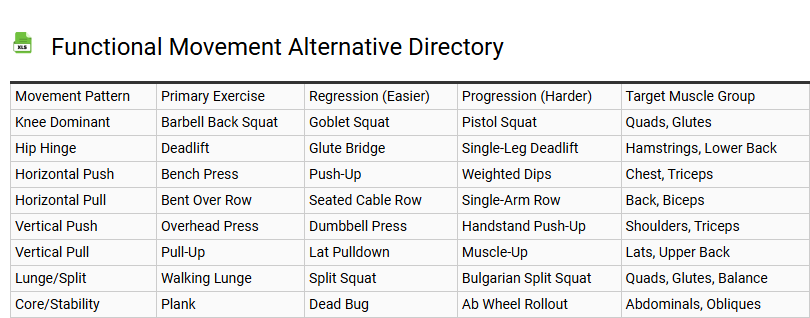
💾 Functional Movement Alternative Directory .xls
Explore a comprehensive functional movement alternative directory designed to optimize your biomechanics and enhance kinetic chain efficiency. This curated resource catalogs diverse corrective exercises and mobility training protocols tailored for those seeking to refine fundamental movement patterns and improve postural alignment.
By integrating evidence-based strength and conditioning strategies, users can discover therapeutic modalities that serve as effective substitutes for traditional gym routines. Each entry focuses on injury prevention, increasing range of motion, and addressing muscle imbalances to boost overall athletic performance. Whether you are interested in proprioceptive drills, dynamic stability, or neuromuscular efficiency, this directory provides essential tools for achieving functional longevity and holistic physical wellness. Bridge the gap between physical therapy and fitness through our expertly selected movement-based alternatives.
Hypertrophy Exercise Swap Guide
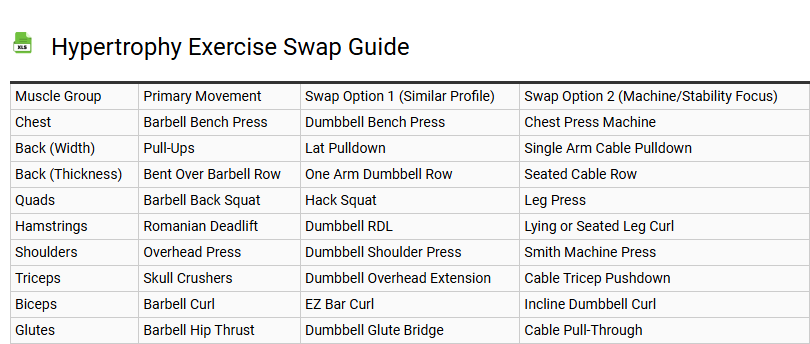
💾 Hypertrophy Exercise Swap Guide .xls
Optimizing muscle growth requires a strategic approach to movement selection. This hypertrophy exercise swap guide facilitates seamless transitions between movements while maintaining mechanical tension and metabolic stress. When substituting exercises, focus on matching the biomechanics and resistance profile of the original lift to preserve the intended hypertrophic stimulus.
Effective swaps prioritize the following variables:
- Movement Patterns: Categorize by push, pull, hinge, or squat to ensure consistent muscle fiber recruitment and joint alignment.
- Stability: Choose alternative exercises like resistance machines or cables to manage the stimulus-to-fatigue ratio (SFR).
- Range of Motion: Select tools that allow for a deep weighted stretch and full active ROM.
By utilizing these training modifications, you can bypass equipment limitations and overcome plateaus without sacrificing volume or intensity in your hypertrophy program.
Limited Space Workout Substitutions
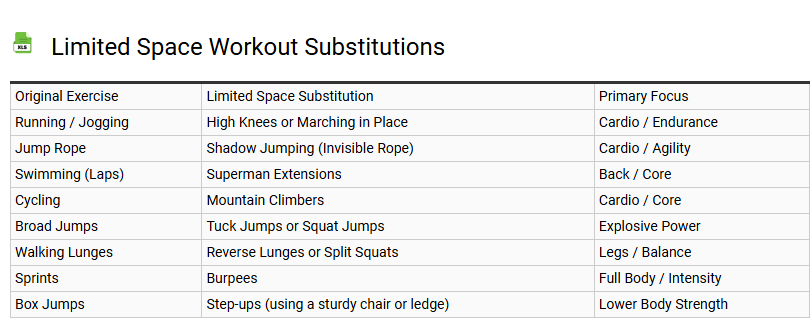
💾 Limited Space Workout Substitutions .xls
Optimizing fitness routines in confined environments requires strategic exercise alternatives that prioritize vertical displacement over lateral movement. When floor area is a premium, swap expansive plyometrics for stationary variations like high knees, mountain climbers, or shadowboxing to maintain cardiovascular intensity. For strength training, utilize isometric holds and time-under-tension techniques to maximize muscle fiber recruitment without bulky equipment. Resistance bands offer a portable solution for hypertrophy, effectively replacing traditional cable machines within a minimal footprint.
Implementing low-impact modifications, such as reverse lunges instead of walking lunges, preserves joint health while respecting spatial constraints. By focusing on functional movement patterns and bodyweight resistance, athletes can achieve high-performance results. These compact training adaptations ensure that small-space constraints never compromise your physical conditioning or range of motion. Utilizing these substitutions transforms any small room into a high-efficiency metabolic conditioning zone.
Joint-Friendly Exercise Alternatives
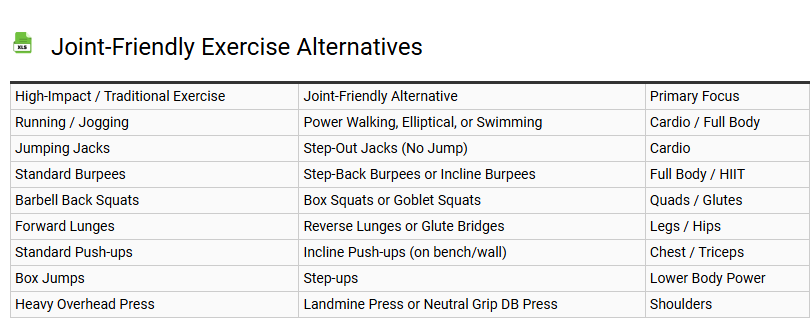
💾 Joint-Friendly Exercise Alternatives .xls
Implementing joint-friendly exercise alternatives is essential for maintaining long-term mobility and orthopedic health. By substituting high-impact activities with low-stress training modalities, individuals can preserve cartilage integrity while achieving peak cardiovascular fitness. Focus on low-impact workouts such as aquatic therapy, cycling, or elliptical training to minimize ground reaction forces on the knees and ankles.
Incorporate modified movements like goblet squats or floor-based glute bridges to reduce spinal loading and hip strain. Utilizing resistance bands provides constant tension without taxing connective tissues. These strategic adaptations stimulate synovial fluid production, enhancing lubricated range of motion without exacerbating chronic inflammation. Prioritizing biomechanical alignment through isometric holds and controlled eccentric phases ensures muscle activation while shielding vulnerable joints from repetitive strain. This approach balances metabolic demands with injury prevention, fostering sustainable physical longevity and functional strength.
This Exercise Substitution Reference Guide template provides a versatile framework for customizing any fitness program. By identifying alternative movements based on shared biomechanics and target muscle groups, users maintain training intensity despite limited equipment or physical constraints.
This essential tool ensures workout consistency, helping athletes overcome plateaus and prevent injuries. Whether transitioning to a home gym or refining functional strength, this guide simplifies exercise selection for optimal results and seamless training progression.