
Hypertrophy Volume Tracker Template for Targeted Muscle Growth
Optimizing muscle growth requires precise data management and consistency. A Hypertrophy Volume Tracker serves as an essential tool for monitoring progressive overload, ensuring measurable gains in muscle mass over time. By meticulously documenting sets, reps, and intensity, athletes can effectively analyze training frequency and systemic recovery. This structured approach to strength training helps identify performance plateaus and refine workout routines for peak physiological adaptation. Explore our collection to find a specialized variation of templates below.
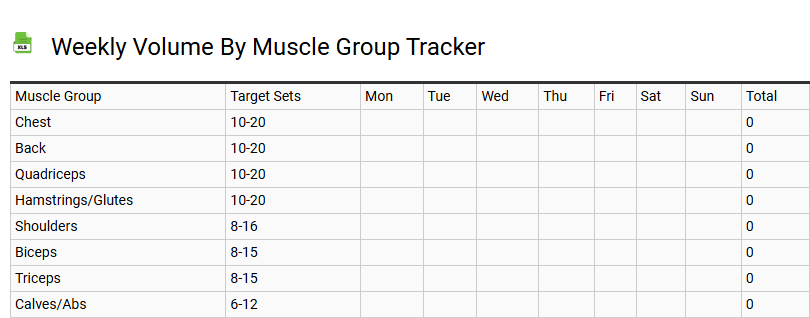
Weekly Volume by Muscle Group Tracker
💾 Weekly Volume by Muscle Group Tracker .xls
A weekly volume by muscle group tracker is an essential tool for mastering hypertrophy and ensuring progressive overload. By monitoring total working sets per microcycle, athletes can precisely manage training frequency and systemic recovery. This template categorizes resistance exercises into major muscle groups-such as the pectorals, latissimus dorsi, and quadriceps-to prevent overtraining while hitting specific volume milestones.
- Monitor maintenance volume versus maximal recoverable volume (MRV).
- Identify muscular imbalances through precise quantitative data.
- Optimize exercise selection to enhance metabolic stress and tension.
Utilizing this log facilitates effective periodization, allowing lifters to scale intensity and load strategically. Consistent tracking transforms raw gym data into a roadmap for sustained strength gains and muscular development, ensuring every set contributes to your long-term fitness objectives.
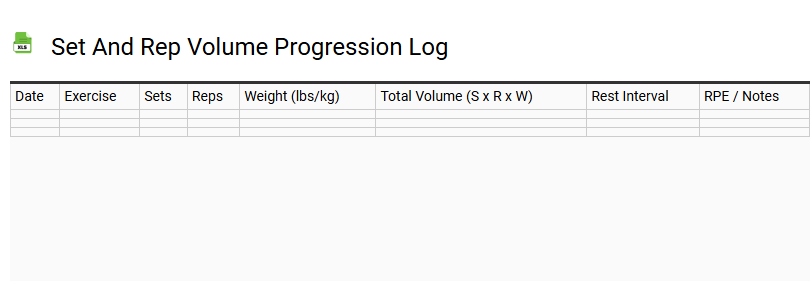
Set and Rep Volume Progression Log
💾 Set and Rep Volume Progression Log .xls
A set and rep volume progression log serves as a strategic framework for monitoring progressive overload and ensuring consistent muscle hypertrophy. By documenting specific training volume, athletes can track the total tonnage lifted across various rep ranges and intensity levels. This systematic approach to workout tracking is essential for managing physiological adaptation and optimizing strength gains.
- Load Management: Precise recording of resistance ensures linear or undulating periodization.
- Performance Metrics: Analyzing work capacity helps identify plateaus and informs recovery cycles.
- Mechanical Tension: Consistent volume increments drive metabolic stress, necessary for muscle growth.
Utilizing a structured training log facilitates data-driven adjustments to exercise selection and frequency. Accurate documentation of incremental volume remains the cornerstone of effective resistance training and long-term athletic performance.
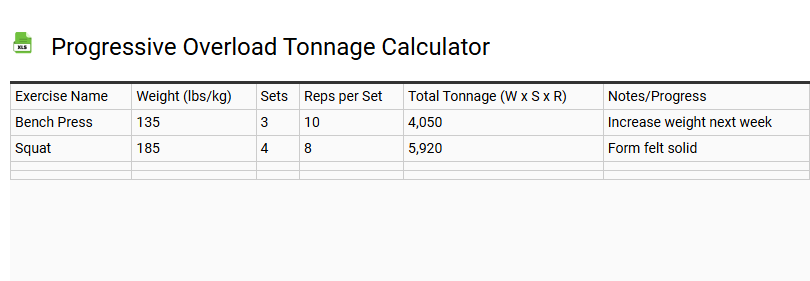
Progressive Overload Tonnage Calculator
💾 Progressive Overload Tonnage Calculator .xls
Utilize this Progressive Overload Tonnage Calculator to accurately quantify your total training volume and drive consistent physiological adaptation. By calculating tonnage-the product of sets, repetitions, and resistance-athletes can monitor the mechanical tension required for muscle hypertrophy and strength gains.
Tracking these lifting stats is essential for overcoming plateaus and ensuring systematic intensity adjustments over successive training cycles. This tool helps visualize volume blocks and workload distribution, allowing for data-driven decisions regarding incremental resistance. Whether performing compound lifts or isolation movements, monitoring your cumulative load ensures the necessary stimulus for lean mass accrual.
Mastering the principle of progressive overload requires precise performance metrics. Use this calculator to refine your programming, optimize metabolic stress, and achieve peak physical conditioning through structured volume tracking and recovery management.
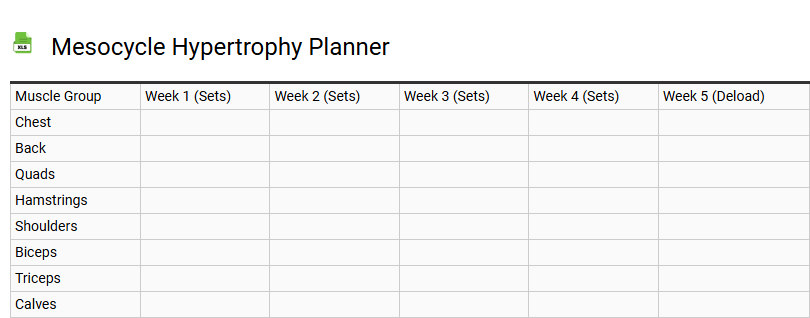
Mesocycle Hypertrophy Planner
💾 Mesocycle Hypertrophy Planner .xls
A mesocycle hypertrophy planner serves as a foundational roadmap for structured muscle growth and physiological adaptation. This specialized training block, typically spanning four to eight weeks, prioritizes muscle protein synthesis through strategic progressive overload and calculated volume accumulation. By utilizing a dedicated hypertrophy template, athletes can meticulously track Reps in Reserve (RIR) across every microcycle, ensuring optimal mechanical tension and metabolic stress without premature burnout.
Effective planners integrate precise exercise selection tailored to specific hypertrophy rep ranges, facilitating consistent resistance training progression. Essential components of a robust planner include:
- Tracking set volume and frequency per muscle group.
- Managing intensity to avoid systemic fatigue.
- Scheduling a mandatory deload phase for recovery.
This systematic approach optimizes the anabolic window, ensuring long-term gains while minimizing injury risks during high-intensity training phases.
Bodybuilding Split Volume Monitor
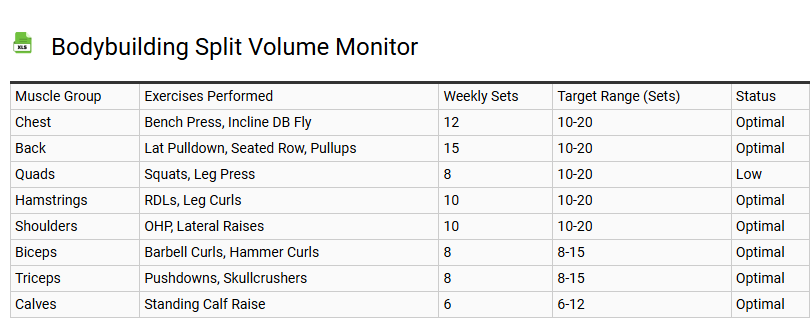
💾 Bodybuilding Split Volume Monitor .xls
A Bodybuilding Split Volume Monitor is an essential tool for athletes targeting muscle hypertrophy through systematic progressive overload. By quantifying total weekly sets per specific muscle group, this template ensures optimal training frequency while mitigating the risk of overtraining. Precise volume tracking allows lifters to audit their exercise selection and distribution across various split patterns, such as PPL or upper-lower routines.
Effective monitoring incorporates critical metrics like RPE (Rate of Perceived Exertion), load intensity, and total repetitions to refine periodization strategies. Managing training volume facilitates superior fatigue management and enhanced recovery rates, which are pivotal for sustained strength gains. Utilizing this structured data approach helps identify lagging body parts and fine-tune physiological adaptations, ensuring every workout contributes to maximal muscular development and long-term athletic success.
Muscle Group Frequency and Volume Log
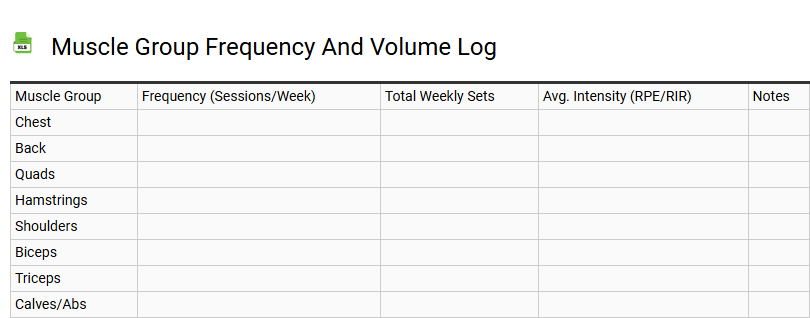
💾 Muscle Group Frequency and Volume Log .xls
This strategic muscle group frequency and volume log template optimizes hypertrophy by tracking key performance indicators across your training cycle. Monitor your weekly sets, repetitions, and total workload per body part-including the chest, posterior chain, and quads-to ensure an adequate stimulus for muscle protein synthesis.
By documenting training density and intensity, athletes can effectively manage systemic fatigue and prioritize essential recovery windows. Utilize this tracking system to implement progressive overload, adjusting resistance based on objective data. Whether you are executing high-frequency splits or dedicated volume blocks, this log facilitates precise mesocycle adjustments. Ensuring each major muscle group receives optimal mechanical tension is vital for sustained strength gains and muscular development within any structured fitness program.
RPE-Based Volume Intensity Sheet
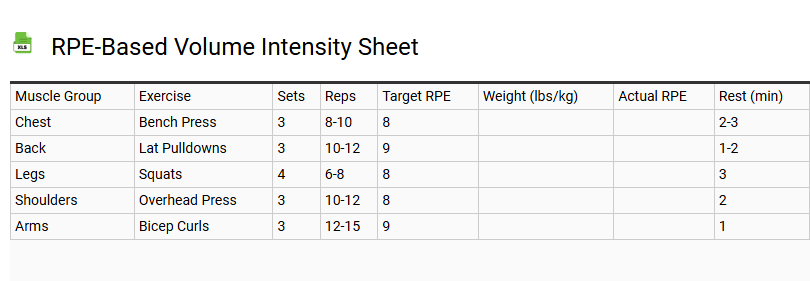
💾 RPE-Based Volume Intensity Sheet .xls
This RPE-based volume intensity sheet serves as a sophisticated tool for tracking resistance training through autoregulation. By utilizing the Rate of Perceived Exertion scale, athletes can fine-tune their daily workload based on neurological fatigue and recovery capacity. This template integrates variables such as sets, reps, and load to calculate total tonnage while maintaining optimal relative intensity.
Unlike rigid percentage-based programming, an RPE log accounts for repetitions in reserve (RIR), ensuring consistent progressive overload without risking overtraining. It facilitates precise periodization by visualizing the relationship between training volume and intensity zones. Ideal for powerlifting and bodybuilding, this spreadsheet optimizes hypertrophy and strength gains by allowing real-time adjustments to the training load. Use this framework to monitor physiological adaptations and manage fatigue across various mesocycles for peak athletic performance.
Max Recoverable Volume Tracker
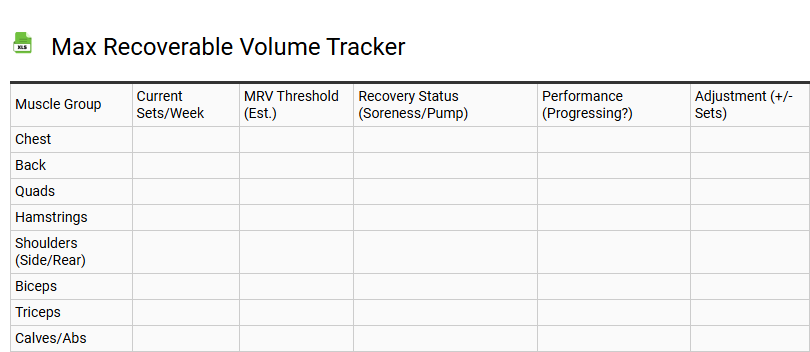
💾 Max Recoverable Volume Tracker .xls
The Max Recoverable Volume (MRV) tracker is an essential instrument for hypertrophy training and fatigue management. This template systematically monitors the highest training volume an athlete can perform while still making positive adaptations. By documenting weekly sets, rep ranges, and relative intensity, users can pinpoint their unique recovery capacity to maximize muscle protein synthesis.
Utilizing this tracker facilitates progressive overload and helps prevent non-functional overreaching. It optimizes the stimulus-to-fatigue ratio, ensuring that training stress translates into muscle growth rather than adaptive resistance. Key features include:
- Monitoring delayed onset muscle soreness (DOMS) and joint integrity.
- Adjusting volume landmarks from minimum effective volume (MEV) to peak thresholds.
- Tracking performance markers to determine mesocycle length.
- Data-driven deload scheduling based on accumulated fatigue.
This structured approach ensures peak athletic performance and long-term physiological adaptation.
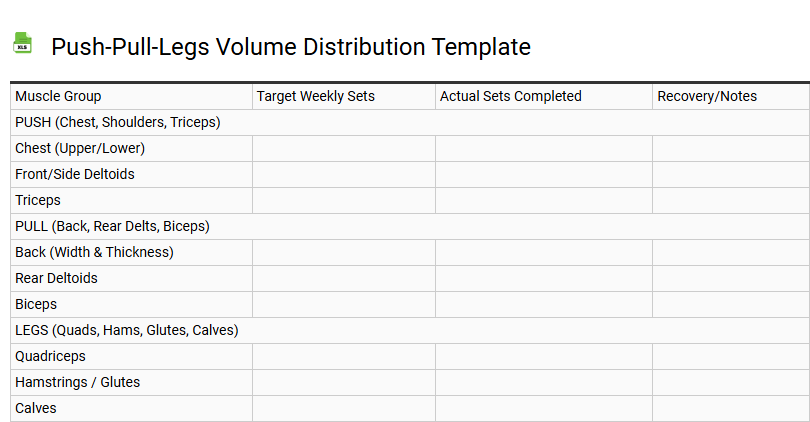
Push-Pull-Legs Volume Distribution Template
💾 Push-Pull-Legs Volume Distribution Template .xls
Optimizing a Push-Pull-Legs (PPL) volume distribution template is essential for maximizing hypertrophy and strength gains. This structured training split categorizes exercises by functional movement patterns to ensure targeted muscle stimulation while managing systemic fatigue. By organizing workouts into push (chest, shoulders, triceps), pull (back, biceps), and legs (quadriceps, hamstrings), athletes can achieve a high weekly frequency without overtraining.
Effective volume distribution involves balancing compound movements with isolation exercises. Aim for 10–20 hard sets per muscle group weekly to trigger muscle protein synthesis and facilitate progressive overload. This template prioritizes recovery, allowing specific muscle groups to rest while others are under tension. Whether following a three-day or six-day rotation, focusing on intensity and strategic set volume ensures a balanced physique, improved work capacity, and consistent long-term athletic development.
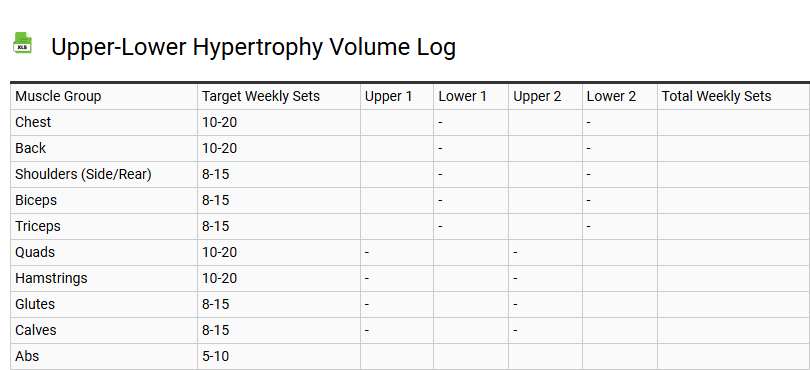
Upper-Lower Hypertrophy Volume Log
💾 Upper-Lower Hypertrophy Volume Log .xls
Optimize your muscle growth journey with this comprehensive upper-lower hypertrophy volume log. Designed for strategic resistance training, this template prioritizes progressive overload by tracking total workload across specific rep ranges. By categorizing compound movements and isolation exercises, athletes can monitor mechanical tension and metabolic stress effectively.
This systematic approach to training frequency ensures adequate recovery between high-intensity hypertrophy cycles. Detailed logging of sets, reps, and RPE facilitates precise volume management, which is essential for maximizing protein synthesis and achieving consistent strength gains. Whether you are navigating a periodization phase or refining your physique, this log provides the data necessary to adjust muscle fiber recruitment strategies. Use these insights to enhance your body composition through data-driven performance tracking and disciplined training volume adjustments.
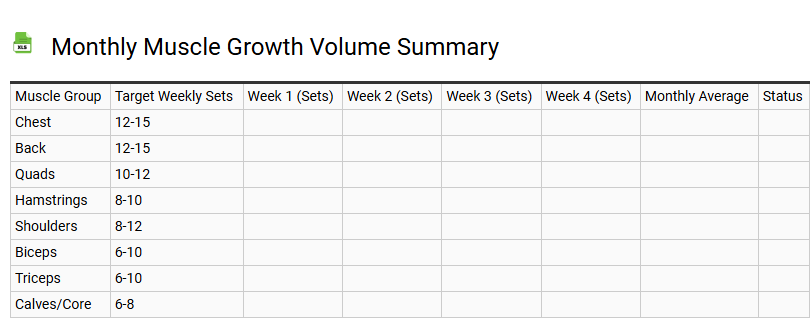
Monthly Muscle Growth Volume Summary
💾 Monthly Muscle Growth Volume Summary .xls
A Monthly Muscle Growth Volume Summary serves as a critical diagnostic tool for tracking hypertrophy progress and ensuring consistent progressive overload. This template quantifies total workload by calculating the product of sets, repetitions, and load across targeted muscle groups. By monitoring these metrics, athletes can effectively balance mechanical tension and metabolic stress, the primary drivers of muscle protein synthesis.
Effective summaries evaluate training intensity using RPE (Rate of Perceived Exertion) to prevent overtraining while optimizing recovery phases. Integrating periodization strategies allows for precise adjustments in training frequency and exercise selection, specifically balancing compound movements with isolation exercises. This data-driven overview identifies plateaus early, facilitating necessary adjustments to volume load and rest intervals to sustain physiological adaptation and long-term strength development within a structured fitness regimen.
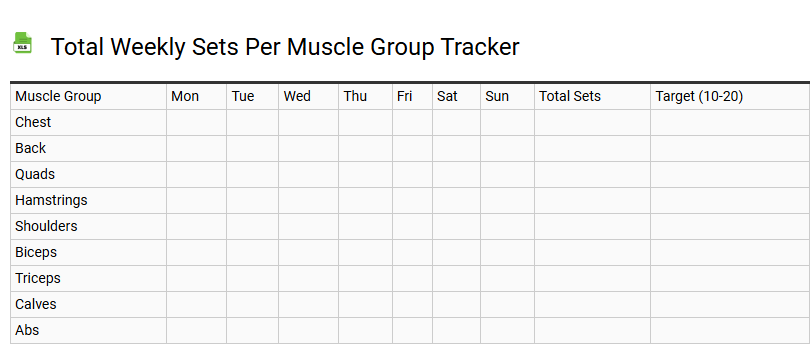
Total Weekly Sets Per Muscle Group Tracker
💾 Total Weekly Sets Per Muscle Group Tracker .xls
Optimizing hypertrophy requires precise management of training volume. A Total Weekly Sets Per Muscle Group Tracker serves as a vital fitness log, ensuring athletes maintain the ideal balance between progressive overload and muscle recovery. By documenting the exact set count for compound movements and isolation exercises, lifters can fine-tune their exercise programming to maximize strength gains.
Effective volume tracking involves monitoring several key metrics:
- Frequency: How often each muscle group is stimulated weekly.
- Workload Distribution: Balancing intensity across major muscle groups to prevent imbalances.
- Overtraining Prevention: Identifying excessive volume benchmarks that may hinder muscle protein synthesis.
Implementing this data-driven approach allows for systematic adjustments in bodybuilding routines, ensuring that total weekly sets align with specific physiological goals and long-term athletic performance.
Exercise-Specific Volume Load Chart
💾 Exercise-Specific Volume Load Chart .xls
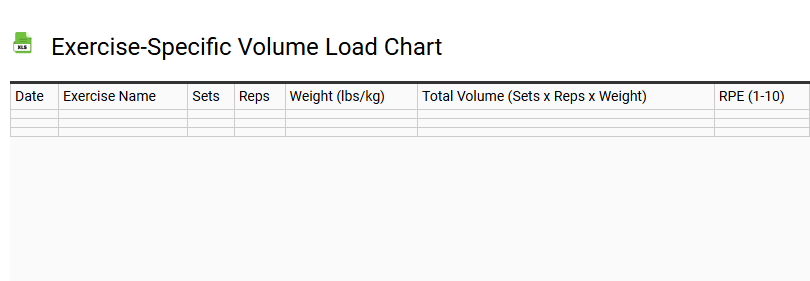
An Exercise-Specific Volume Load Chart is an essential tool for athletes utilizing progressive overload to drive hypertrophy and strength gains. By calculating total tonnage-the product of sets, repetitions, and weight-this template quantifies the mechanical tension and physiological stress placed on specific muscle groups.
Monitoring these metrics allows for a data-driven approach to strength training, ensuring consistent adaptation while preventing plateaus. This structured tracking method helps lifters balance training intensity with recovery, optimizing the workload for peak performance. Whether your goal is muscular endurance or maximal power, recording volume load trends provides the necessary insights to fine-tune your programming. Implementing this template fosters incremental improvements in work capacity, transforming raw workout data into a strategic roadmap for long-term athletic development and physique refinement.
Periodized Hypertrophy Volume Sheet
💾 Periodized Hypertrophy Volume Sheet .xls
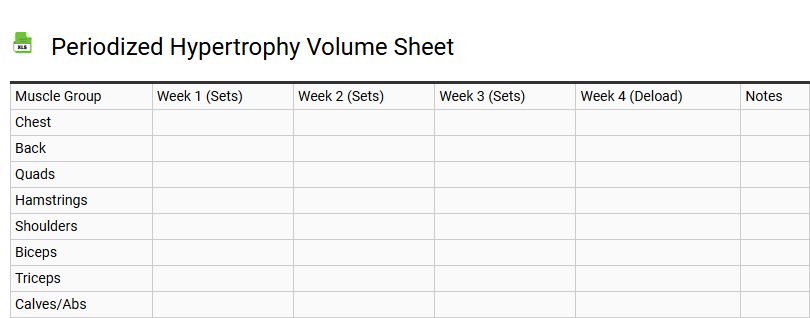
A Periodized Hypertrophy Volume Sheet is a strategic framework designed to track and scale training stress across specific mesocycles. This tool facilitates progressive overload by systematically adjusting sets, repetitions, and load to maximize muscle protein synthesis while mitigating systemic fatigue.
To optimize hypertrophy, the template focuses on several critical data points:
- Volume Landmarks: Monitoring Minimum Effective Volume (MEV) and Maximum Recoverable Volume (MRV) to ensure productive training stimulus.
- Intensity Management: Tracking RPE (Rate of Perceived Exertion) or RIR (Reps in Reserve) to maintain proximity to failure.
- Phasic Progression: Organizing accumulation weeks followed by a dedicated deload to facilitate physiological recovery.
Utilizing this structured approach allows athletes to visualize longitudinal progress, refine exercise selection, and ensure that total work capacity increases over time, leading to superior lean mass accrual and injury prevention.
Compound vs Isolation Volume Ratio Tracker
💾 Compound vs Isolation Volume Ratio Tracker .xls
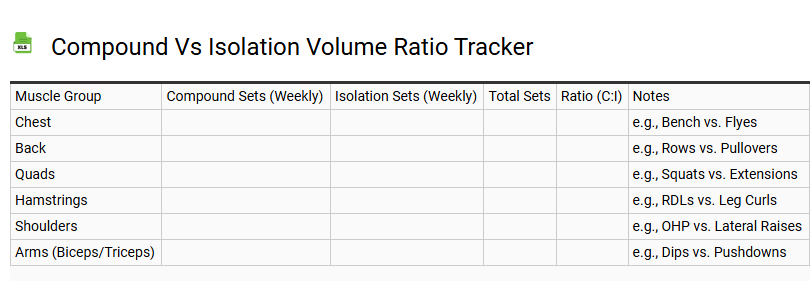
This Compound vs. Isolation Volume Ratio Tracker is a specialized tool designed to optimize hypertrophy and mechanical tension within a structured training program. By quantifying the balance between multi-joint structural lifts and single-joint accessory movements, athletes can refine their exercise selection to maximize muscle fiber recruitment while effectively managing central nervous system (CNS) fatigue.
Maintaining a strategic ratio ensures that metabolic stress is achieved without compromising the progressive overload of primary lifts. This template monitors weekly sets across specific muscle groups, distinguishing between heavy compound movements and targeted isolation exercises. Utilizing this data-driven approach prevents overtraining and promotes symmetrical muscular development. By aligning training frequency with individual recovery capacity, lifters can ensure that every rep range contributes to sustained physiological adaptation and peak performance.
A hypertrophy volume tracker is a vital tool for documenting progressive overload and ensuring consistent muscle growth. This template allows lifters to monitor sets, reps, and tonnage, providing a clear overview of training volume across various muscle groups. By utilizing a structured workout log, you can refine exercise selection and frequency for optimal skeletal muscle development.
Leveraging this spreadsheet ensures data-driven adjustments to your bodybuilding routine, effectively preventing plateaus and maximizing long-term strength gains.