
Leangains Protocol Journal Template: Tracking Progress and Performance
Achieving peak body composition requires meticulous tracking through a Leangains Protocol Journal. By documenting your intermittent fasting windows, macronutrient cycling, and heavy strength training sessions, you ensure total adherence to the 16:8 methodology. Monitoring caloric intake and progress in compound lifts allows for precise adjustments to your physique goals. Whether you are focusing on fasted training or reverse pyramid sets, a structured log provides the data necessary for consistent growth. Please check the already made variation of templates below.
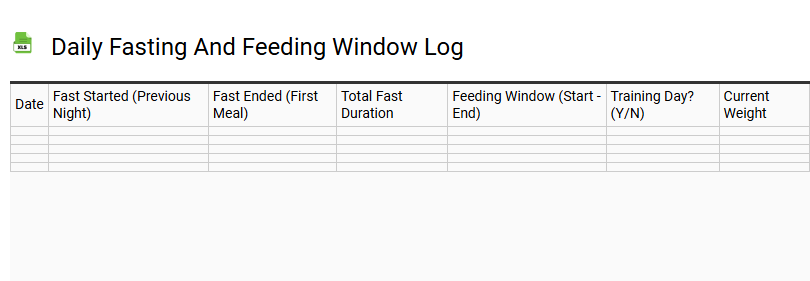
Daily Fasting and Feeding Window Log
💾 Daily Fasting and Feeding Window Log .xls
A daily fasting and feeding window log serves as a vital tool for mastering intermittent fasting protocols and achieving peak metabolic health. By meticulously documenting your fasted state and nutritional intake periods, you can effectively synchronize your circadian rhythm and trigger autophagy. This template facilitates precise tracking of time-restricted eating schedules, whether utilizing a 16:8, 20:4, or OMAD ratio. Consistent monitoring enhances insulin sensitivity, manages caloric consumption, and promotes sustainable weight management. Integrating this health optimization log ensures nutritional consistency while providing data-driven insights into your body's metabolic flexibility. Streamline your wellness journey by recording precise start and end times to maintain a disciplined feeding window for improved physiological performance and hormonal balance.
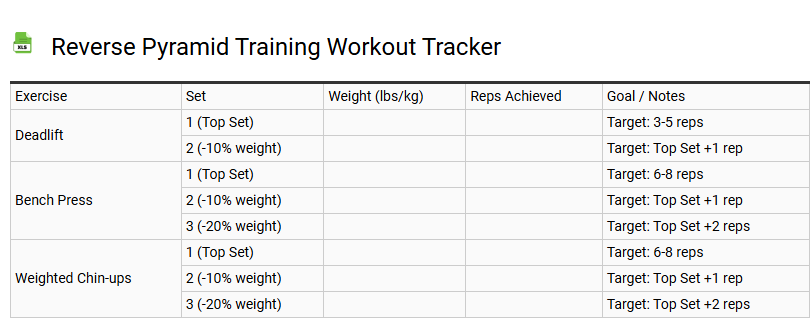
Reverse Pyramid Training Workout Tracker
💾 Reverse Pyramid Training Workout Tracker .xls
This Reverse Pyramid Training (RPT) workout tracker is engineered to maximize muscle hypertrophy and strength gains through strategic intensity management. By prioritizing the heaviest load during the initial top set when neurological energy is peaked, users trigger maximal mechanical tension and fiber recruitment. Subsequent sets utilize calculated weight increments-usually a 10% reduction-paired with increased repetitions to sustain metabolic stress while managing fatigue.
The template captures essential performance tracking metrics, including RPE (Rate of Perceived Exertion), rest periods, and total training volume. Optimized for heavy compound movements, this log ensures progressive overload by documenting specific resistance levels and rep counts. Utilizing this structured approach allows athletes to bypass plateaus, balancing high-intensity efforts with sufficient recovery to facilitate consistent physiological adaptations and lean mass development.
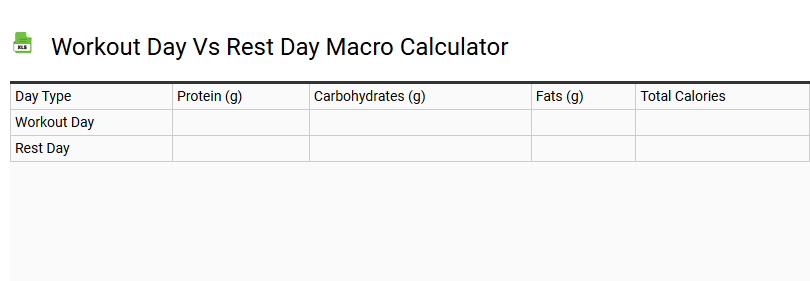
Workout Day vs Rest Day Macro Calculator
💾 Workout Day vs Rest Day Macro Calculator .xls
Optimizing your nutritional intake requires a strategic approach to macronutrient ratios based on daily energy expenditure. This macro calculator utilizes carb cycling principles to differentiate between high-intensity training and recovery periods. On a workout day, the focus shifts toward higher carbohydrate intake to fuel glycogen stores and support muscle protein synthesis.
Conversely, rest day macros prioritize healthy fats and lean protein to facilitate tissue repair while maintaining a caloric deficit or maintenance level. Key benefits of this body recomposition strategy include:
- Improved insulin sensitivity through varied glucose demand.
- Enhanced metabolic flexibility during sedentary hours.
- Precise TDEE (Total Daily Energy Expenditure) adjustments.
By inputting your basal metabolic rate and activity levels, this template provides a custom blueprint for fat loss or muscle gain, ensuring optimal nutrient timing for peak physical performance.
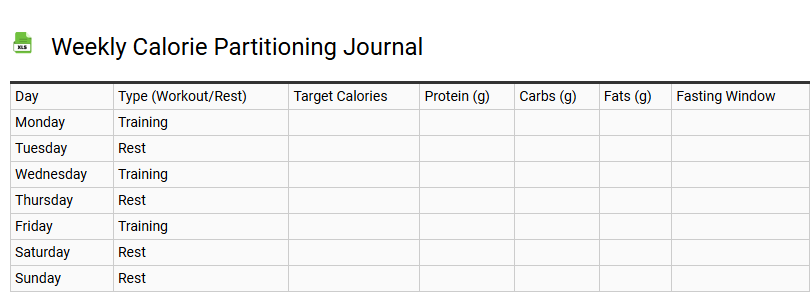
Weekly Calorie Partitioning Journal
💾 Weekly Calorie Partitioning Journal .xls
This Weekly Calorie Partitioning Journal serves as a strategic framework for mastering metabolic flexibility and energy balance. By implementing calorie cycling, users can fine-tune their nutritional planning to align with specific activity levels. This template facilitates precise macronutrient distribution, allowing for a calculated caloric deficit on sedentary days and maintenance calories during recovery periods. Integrating zigzag dieting principles within this log helps prevent metabolic adaptation while optimizing weight management outcomes. By documenting your daily intake and caloric surplus requirements, you gain total control over body composition. This fitness tracking tool simplifies meal timing and the complexities of nutrient partitioning. Maintaining a consistent record of energy expenditure versus consumption ensures long-term dietary adherence and peak physical performance throughout your transformation journey.
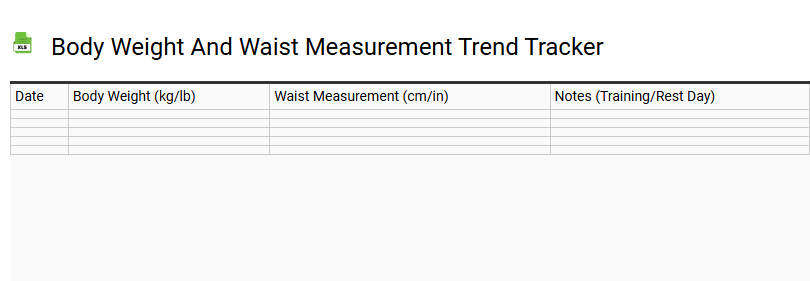
Body Weight and Waist Measurement Trend Tracker
💾 Body Weight and Waist Measurement Trend Tracker .xls
This body weight and waist measurement trend tracker provides a precise framework for monitoring body composition and physical transformation. By documenting abdominal circumference alongside total mass, individuals gain deeper insights into visceral fat levels and metabolic health, offering a superior alternative to standard BMI metrics.
Consistent data entry allows for the identification of patterns related to caloric deficits, muscle hypertrophy, and hydration fluctuations. Utilizing this systematic log helps distinguish between lean mass retention and adipose tissue reduction. Whether tracking a weight loss journey or fitness progress, visualizing these health metrics over time fosters accountability and informs necessary adjustments to nutrition and exercise protocols. This template serves as a vital tool for capturing physiological changes and ensuring long-term adherence to wellness objectives through data-driven progress monitoring.
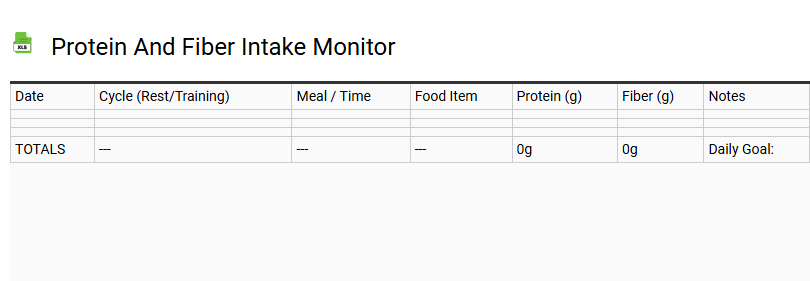
Protein and Fiber Intake Monitor
💾 Protein and Fiber Intake Monitor .xls
Optimizing your daily nutrition requires a precise Protein and Fiber Intake Monitor to balance essential macronutrients effectively. This specialized tracking template helps users maintain metabolic health by recording amino acid consumption alongside dietary fiber levels. Prioritizing these two components is crucial for lean muscle preservation, sustained satiety, and efficient digestive wellness.
By utilizing a digital logging system, individuals can visualize their progress toward specific nutritional goals. Key benefits of integrated monitoring include:
- Improved blood sugar regulation through consistent roughage intake.
- Enhanced thermogenesis and metabolic rate via high-quality protein sources.
- Optimized gut microbiome diversity and regular bowel function.
Refining your nutrient density through data-driven insights ensures long-term weight management and athletic performance, transforming raw dietary data into actionable wellness strategies for a healthier lifestyle.
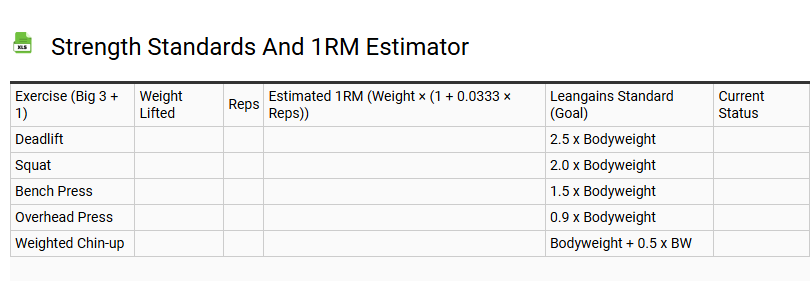
Strength Standards and 1RM Estimator
💾 Strength Standards and 1RM Estimator .xls
This tool provides a structured framework to evaluate your lifting performance relative to established benchmarks for your body weight and experience level. By utilizing the integrated One-Rep Max (1RM) estimator, you can safely project your peak strength capacity using sub-maximal data. Simply input the weight lifted and the number of successful repetitions to generate an accurate performance profile.
Understanding these metrics allows you to:
- Categorize your current proficiency from novice to elite levels.
- Calculate precise training loads for various programming cycles.
- Track objective progress over time to ensure consistent physiological adaptation.
Whether you are refining a powerlifting routine or improving general fitness, these figures serve as a vital baseline for identifying mechanical weaknesses and optimizing your path toward new personal records. Use these data points to bridge the gap between current output and your ultimate strength potential.
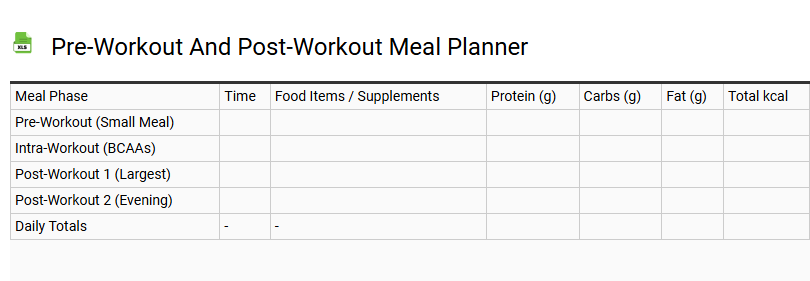
Pre-Workout and Post-Workout Meal Planner
💾 Pre-Workout and Post-Workout Meal Planner .xls
Maximize your fitness results by utilizing a structured Pre-Workout and Post-Workout Meal Planner. Effective nutrient timing is essential for peak athletic performance and rapid muscle recovery. Use this template to organize macronutrients, ensuring your body has the fuel needed for high-intensity training and glycogen replenishment.
Prioritize complex carbohydrates and lean proteins before exercise to saturate energy stores and maintain anabolic states. Following your session, focus on protein synthesis by consuming high-quality amino acids and electrolytes to repair tissue damage.
- Pre-Workout: Focus on sustained energy, hydration, and digestive comfort.
- Post-Workout: Target the recovery window with fast-absorbing nutrients to reduce soreness.
- Tracking: Monitor caloric intake and performance correlations to fine-tune your fitness nutrition strategy.
This comprehensive log helps balance blood sugar levels and optimizes metabolic rate for superior body composition.
Monthly Leangains Progress Summary
💾 Monthly Leangains Progress Summary .xls
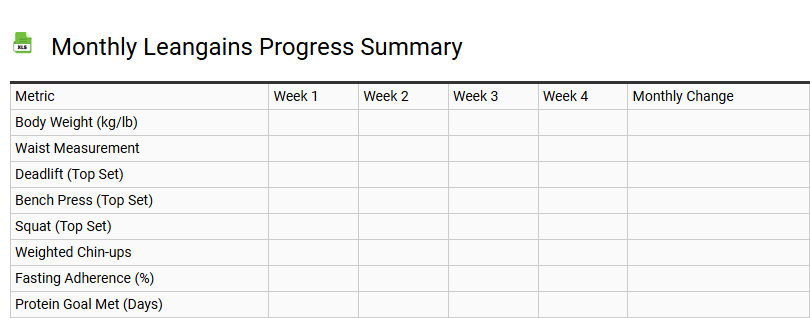
This Monthly Leangains Progress Summary serves as a vital tool for auditing body recomposition and strength milestones. By documenting your adherence to the 16:8 intermittent fasting protocol and Reverse Pyramid Training (RPT) intensity, you can evaluate the efficacy of your current nutritional strategy. This template emphasizes macronutrient cycling, allowing you to track high-carb training days versus high-fat rest days to optimize insulin sensitivity and recovery.
Utilize this summary to monitor key performance indicators, including:
- Average weekly body weight and waist circumference for accurate fat loss tracking.
- Progressive overload data for core compound movements.
- Caloric surplus or deficit margins tailored for lean mass accrual.
Consistently logging these variables ensures that muscle protein synthesis remains peaked while maintaining a lean physique through a data-driven application of the Berkhan method.
Refeed and Maintenance Day Log
💾 Refeed and Maintenance Day Log .xls
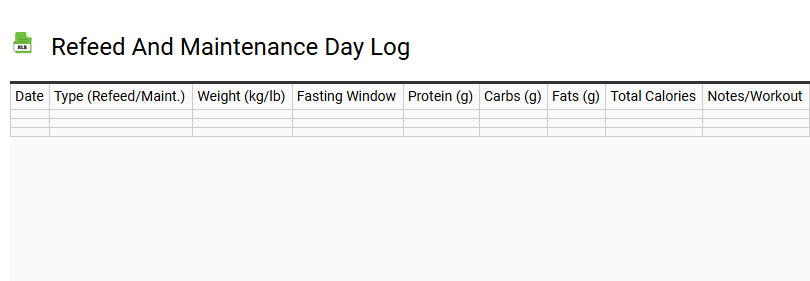
A structured Refeed and Maintenance Day Log serves as a vital tool for tracking caloric intake adjustments and metabolic health. During a refeed period, the focus shifts to glycogen replenishment and boosting leptin levels through controlled carbohydrate loading. This strategy helps mitigate metabolic adaptation caused by prolonged caloric deficits.
Utilizing this template allows users to monitor TDEE (Total Daily Energy Expenditure) alignment while prioritizing weight stability. Key metrics to document include:
- Macronutrient distribution specifically targeting high-carb, low-fat ratios.
- Energy levels and subjective workout performance metrics.
- Satiety signals and hunger hormone regulation.
- Daily body weight fluctuations versus long-term averages.
Implementing consistent maintenance days supports hormonal balance and improves dietary adherence. By recording these data points, you optimize nutritional periodization and ensure body composition success without compromising your basal metabolic rate.
Compound Lift Volume Tracker
💾 Compound Lift Volume Tracker .xls
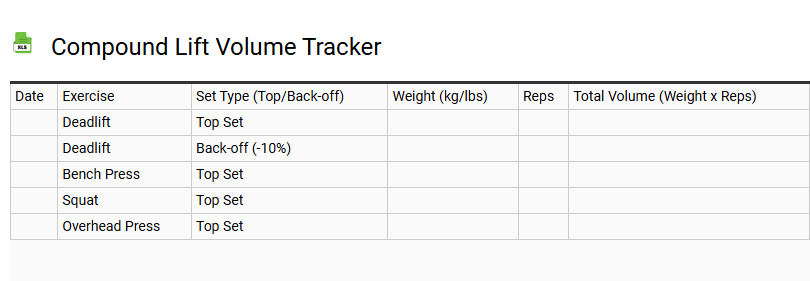
A compound lift volume tracker serves as a functional framework for monitoring total workload across multi-joint exercises like squats, deadlifts, and presses. This system allows athletes to document specific variables, including the number of sets, repetitions, and the load lifted during each session.
By calculating the product of these metrics, the template provides a clear overview of tonnage, which is essential for managing progressive overload. Utilizing a structured log helps in identifying performance trends and ensuring that physical demands increase incrementally over time.
- Track primary movements to ensure balanced development.
- Analyze workload fluctuations to optimize recovery periods.
- Visualize strength progression through objective data points.
Maintaining this detailed record transforms basic workout notes into an actionable strategy for long-term strength gains and physiological adaptation.
Body Fat Percentage Estimator
💾 Body Fat Percentage Estimator .xls
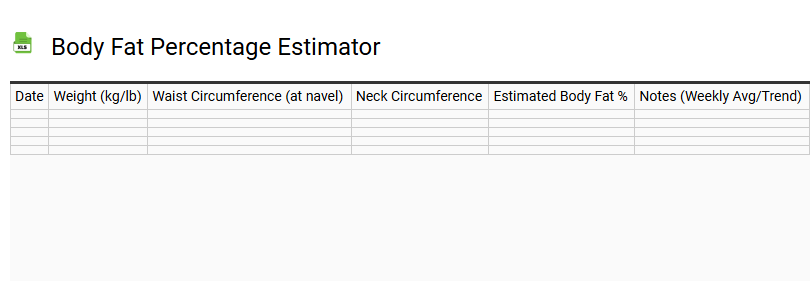
This Body Fat Percentage Estimator provides a precise analysis of body composition by calculating the specific ratio of adipose tissue to total body mass. Unlike a basic body mass index (BMI) calculation, this tool evaluates physical conditioning by distinguishing between lean muscle mass and stored lipids.
By utilizing standardized anthropometric measurements and formulas like the Navy Method, users can effectively monitor subcutaneous fat and metabolic health. This template is essential for tracking fat loss progress, optimizing athletic performance, and assessing risks associated with visceral fat. Whether you integrate data from skinfold calipers or bioelectrical impedance, this estimator simplifies complex physiological metrics into actionable health data. Understanding these markers helps refine nutritional strategies and exercise programming, ensuring a comprehensive view of your overall fitness trajectory and long-term wellness goals.
Non-Exercise Activity Thermogenesis Log
💾 Non-Exercise Activity Thermogenesis Log .xls
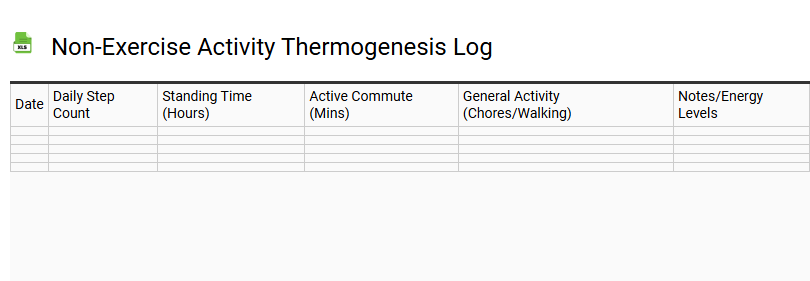
A Non-Exercise Activity Thermogenesis (NEAT) log is an essential tracking tool designed to quantify daily caloric expenditure derived from spontaneous physical activity. Unlike structured gym sessions, NEAT encompasses movement such as walking, gardening, and even fidgeting, which collectively influence your Total Daily Energy Expenditure (TDEE).
Utilizing a comprehensive template allows individuals to monitor key metrics, including:
- Step counts and ambulatory movement patterns.
- Postural transitions and standing duration versus sedentary behavior.
- Occupational activity levels and active commuting.
- Household chores that elevate the metabolic rate.
By documenting these variables, you can optimize your energy balance and support long-term weight management. Tracking low-intensity movement helps bridge the gap between Basal Metabolic Rate (BMR) and active exercise, providing a holistic view of your physical activity level and metabolic health.
Supplements and Micronutrient Checklist
💾 Supplements and Micronutrient Checklist .xls
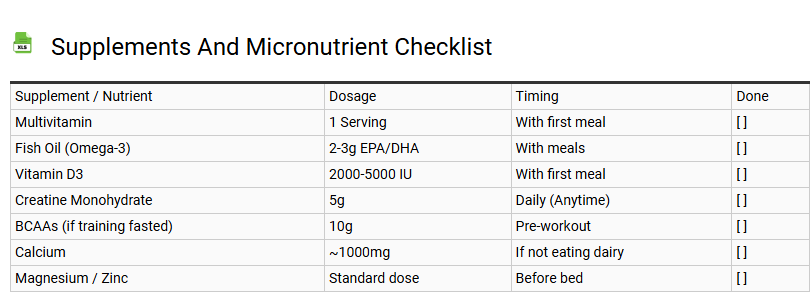
This comprehensive micronutrient checklist serves as a strategic tool for auditing dietary supplement intake and identifying specific nutritional gaps. By monitoring essential vitamins, minerals, and trace elements, you can refine your wellness regimen to enhance bioavailability and metabolic function. This template prioritizes nutrient density, ensuring that daily dosages align with the Recommended Dietary Allowance (RDA) to support long-term health goals.
Tracking fat-soluble vitamins (A, D, E, K) alongside water-soluble complexes improves absorption rates and prevents imbalances. Utilize this structured layout to document bioactive compounds, antioxidants, and electrolytes, fostering a synergy between whole foods and nutraceuticals. Implementing a consistent supplementation protocol ensures precise nutrient timing, promoting cellular repair while maintaining optimal homeostasis through evidence-based nutritional support.
Fast Breaking Meal Journal
💾 Fast Breaking Meal Journal .xls
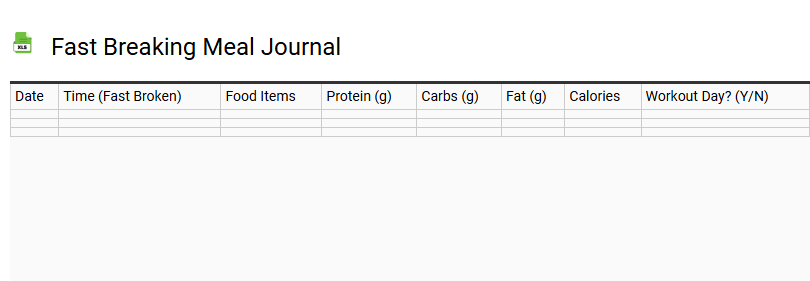
Utilizing a structured Fast Breaking Meal Journal is essential for optimizing your refeeding phase after periods of intermittent fasting. This template facilitates precise meal tracking, allowing you to document nutrient density and observe how various macronutrients influence your blood glucose levels and metabolic health.
By maintaining a detailed food diary, you can monitor key metrics during your post-fast window, including:
- Protein intake for muscle preservation and satiety.
- Healthy fats to support hormonal balance and energy.
- Electrolyte levels and hydration status.
- Digestive health responses and potential food sensitivities.
Consistency in recording your caloric intake and practicing mindful eating promotes metabolic flexibility and sustainable weight management. This systematic approach ensures your body transitions smoothly from a fasted state, prioritizing cellular repair and efficient nutrient absorption.
Utilizing a Leangains Protocol Journal ensures precise tracking of your 16:8 intermittent fasting windows and macronutrient intake. This template streamlines monitoring Reverse Pyramid Training sets, essential for maintaining lean muscle mass during a caloric deficit. By documenting strength training performance and fasting periods, practitioners can optimize body recomposition goals effectively. Adopting this structured logbook simplifies the Martin Berkhan method, fostering consistency in progressive overload and nutritional adherence for long-term fitness success.