
Olympic Weightlifting Technique Checklist Template
Mastering the Snatch and Clean and Jerk requires precision and consistent biomechanics. Utilizing a structured Olympic lifting technique checklist ensures athletes maintain an optimal bar path while achieving full triple extension. This template helps track essential performance markers like footwork, grip width, and catch stability. Whether you are a weightlifting coach or an athlete, documenting these technical nuances improves explosive power and safety. Refine your lifting mechanics and streamline your training log today. Explore the diverse range of professionally designed template variations provided below.
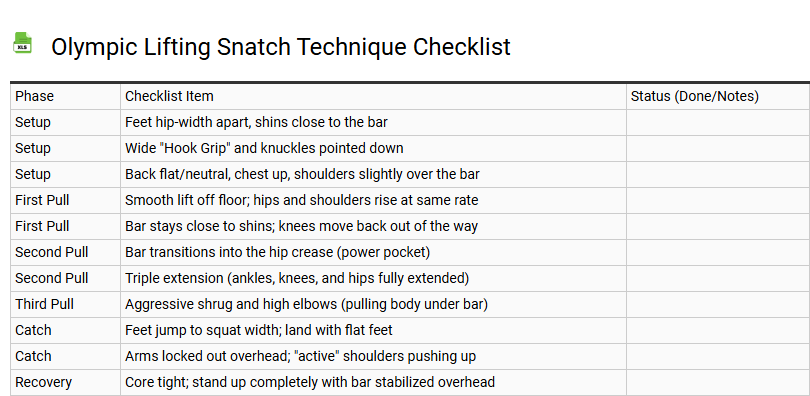
Olympic Lifting Snatch Technique Checklist
💾 Olympic Lifting Snatch Technique Checklist .xls
Executing a flawless Olympic lifting snatch requires a systematic approach to biomechanics and explosive power. This checklist prioritizes the kinetic chain, starting with a precise setup utilizing a hook grip and optimal foot stance. Focusing on these technical milestones ensures peak performance:
- First Pull: Maintaining a neutral spine and active lats while transitioning the barbell from the floor to knee height.
- Power Position: Reaching the hip pocket to facilitate a violent triple extension of the hips, knees, and ankles.
- Turnover: Aggressively pulling under the bar with high elbows to initiate the catch phase.
- Overhead Squat: Stabilizing the load with locked-out arms and deep shoulder mobility in the receiving position.
Refining these elements optimizes bar path efficiency and force production. Consistent practice of these phases is essential for competitive weightlifting success and long-term injury prevention.
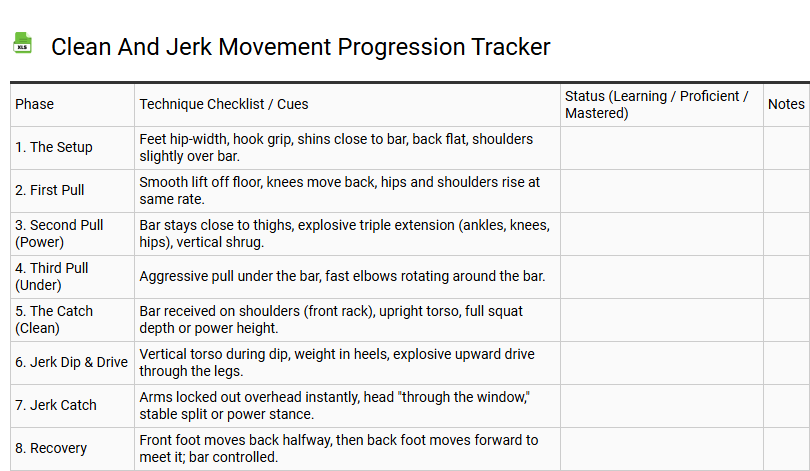
Clean and Jerk Movement Progression Tracker
💾 Clean and Jerk Movement Progression Tracker .xls
Mastering the Clean and Jerk requires precise tracking of technical milestones and strength gains. This Olympic weightlifting progression template allows athletes to monitor their 1RM (one-rep max), volume, and intensity across various training phases. By logging the triple extension, rack position, and overhead stability, lifters can identify specific bottlenecks in their split jerk or power clean mechanics.
Use this log to record essential metrics including:
- Barbell loading and percentage-based training sets.
- RPE (Rate of Perceived Exertion) for effective recovery management.
- Footwork accuracy and lockout consistency during the drive.
- Front squat strength carryover to the clean phase.
Documenting your lifting cues and PRs ensures systematic progressive overload. This tracker bridges the gap between raw strength and technical proficiency, fostering long-term athletic development and peak performance on the platform.
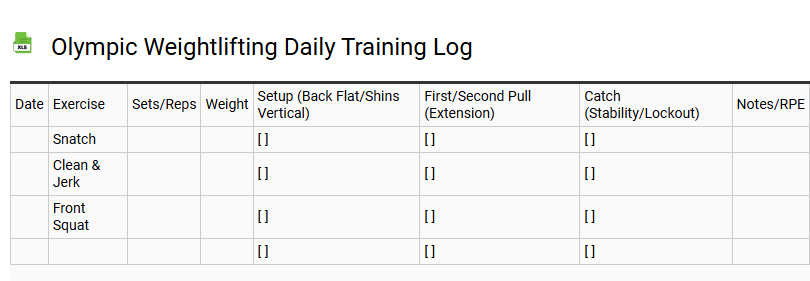
Olympic Weightlifting Daily Training Log
💾 Olympic Weightlifting Daily Training Log .xls
An effective Olympic weightlifting daily training log serves as a vital tool for athletes prioritizing technical proficiency and strength progression. By documenting specific barbell movements such as the snatch, clean and jerk, and front squats, lifters can meticulously track working sets, reps, and intensity percentages.
To optimize strength cycles, this template emphasizes data-driven recovery through the following metrics:
- Volume Load: Total tonnage calculated per session to manage fatigue.
- RPE Scale: Monitoring Rate of Perceived Exertion to adjust loading parameters.
- Accessory Work: Tracking pulls, presses, and mobility drills for structural balance.
Consistently recording biofeedback and lifting mechanics ensures steady improvement toward a new one-repetition maximum (1RM) while maintaining peak performance throughout various mesocycles.
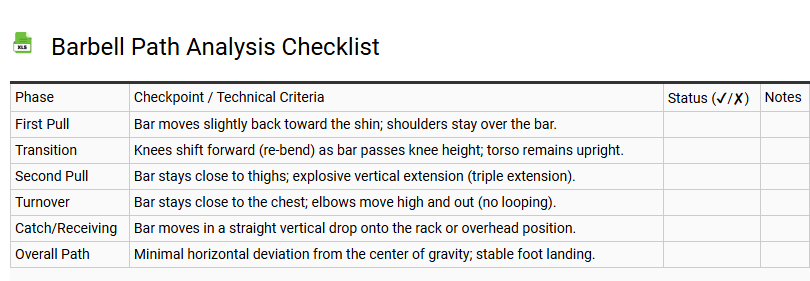
Barbell Path Analysis Checklist
💾 Barbell Path Analysis Checklist .xls
Utilizing a barbell path analysis checklist is a vital diagnostic method for optimizing biomechanical efficiency during compound movements like the snatch, clean, or deadlift. This systematic framework tracks the bar trajectory to minimize horizontal deviation, ensuring the load remains closely aligned with the athlete's center of gravity for maximal stability.
By assessing kinematic data through video feedback, lifters can identify energy leaks and refine vertical displacement. A robust template focuses on several critical performance indicators:
- Initial pull mechanics and limb leverage.
- Barbell velocity and peak power output.
- Turnaround point transitions and catch positioning.
- Consistent force production during the concentric phase.
Integrating these metrics into training enhances technical proficiency, reduces injury risk, and improves neuromuscular recruitment, facilitating superior lift execution and long-term athletic progression in strength sports.
Snatch and Clean Setup Position Audit
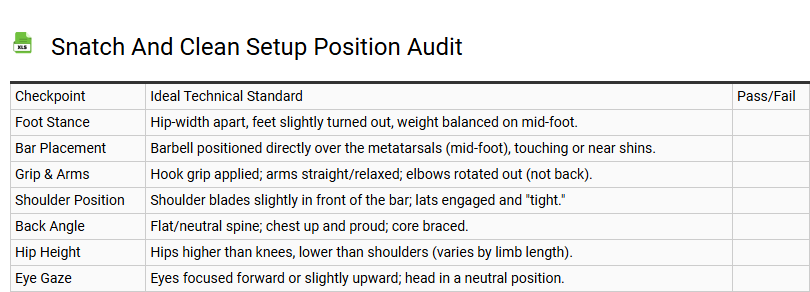
💾 Snatch and Clean Setup Position Audit .xls
A comprehensive Snatch and Clean Setup Position Audit evaluates the biomechanical foundation of Olympic weightlifting. This diagnostic tool focuses on the first pull, ensuring optimal barbell trajectory and kinetic chain efficiency. Key metrics include hip height, lumbar spine alignment, and scapular positioning relative to the bar. During the pulling stance, coaches must verify mid-foot pressure and shin angle to maximize starting strength. Proper grip width and hook grip engagement facilitate lat activation and shoulder stability. By identifying technical deviations in the starting position, athletes can maintain their center of mass, preventing premature hip rise. Refining these biometric markers enhances power output and ensures a seamless transition into the second pull, optimizing technical proficiency for both the snatch and clean and jerk.
Olympic Lifting Accessory Movement Tracker
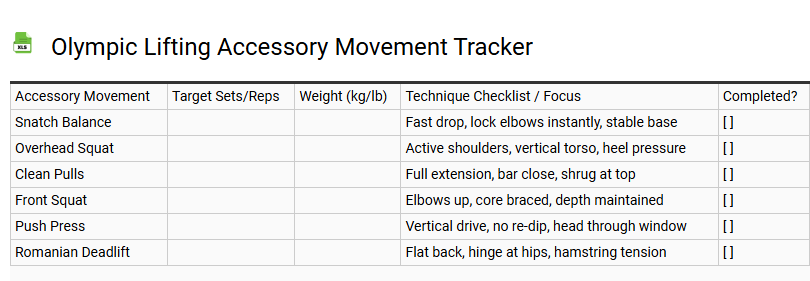
💾 Olympic Lifting Accessory Movement Tracker .xls
Optimize your performance with a specialized Olympic lifting accessory movement tracker. This template facilitates precise strength training by monitoring assistance exercises tailored to enhance the snatch and clean and jerk. By documenting RPE, volume, and intensity, athletes can effectively target weakness correction within the kinetic chain.
- Track pulls and squats to develop explosive power and posterior chain stability.
- Monitor overhead press variations to improve lockout strength and stability.
- Log hypertrophy work to support joint health and functional range of motion.
Utilizing a periodization-focused logbook ensures consistent progressive overload. Refine technical proficiency by analyzing assistance work that reinforces triple extension and barbell mechanics, essential for achieving new 1RM milestones in competitive weightlifting environments.
Olympic Weightlifting Max Effort Progress Chart
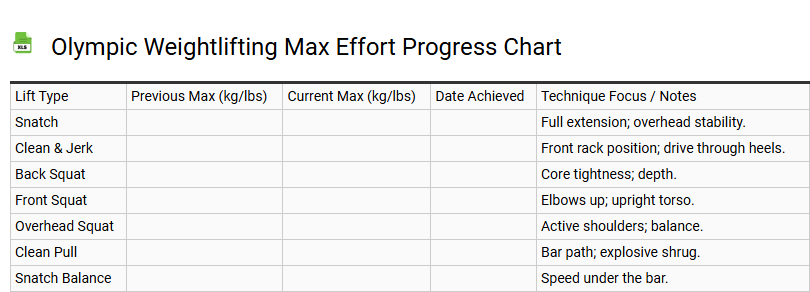
💾 Olympic Weightlifting Max Effort Progress Chart .xls
An Olympic weightlifting max effort progress chart serves as a vital diagnostic tool for athletes mastering the snatch and clean and jerk. By meticulously tracking your one-rep max (1RM), this template facilitates effective periodization and structured strength cycles. Users can monitor fluctuations in training intensity and volume, ensuring that each session aligns with long-term developmental goals.
Key features of this lifting log include:
- Visualizing peak power output over specific macrocycles.
- Analyzing loading parameters to optimize neural adaptation and recovery.
- Tracking personal records (PRs) to gauge technical proficiency and explosive strength.
- Identifying plateaus within hypertrophy or peaking phases.
Utilizing a data-driven approach to your barbell training ensures consistent progression, providing the necessary insights to refine lifting technique and maximize competitive performance on the platform.
Snatch Footwork and Landing Drill Checklist
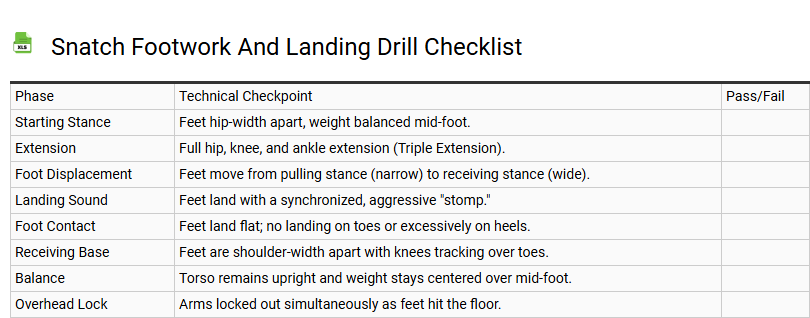
💾 Snatch Footwork and Landing Drill Checklist .xls
Refining a snatch footwork and landing drill is essential for mastering the technical transition between the explosive pull and the receiving position. This checklist ensures optimal Olympic weightlifting mechanics by focusing on the dynamic balance required during the catch phase.
- Stance Transition: Move feet laterally from a pulling width to a stable squat stance for maximum overhead stability.
- Triple Extension: Ensure full hip, knee, and ankle extension before initiating the rapid descent under the barbell.
- Landing Precision: Aim for simultaneous heel contact on the platform to absorb force and maintain a vertical torso angle.
- Weight Distribution: Keep pressure centered through the mid-foot to prevent forward bar drift during the catch position.
Consistently practicing these explosive movements improves kinetic awareness, ensuring a more efficient power position and rock-solid stability during heavy lifts.
Clean and Jerk Fault Correction Log
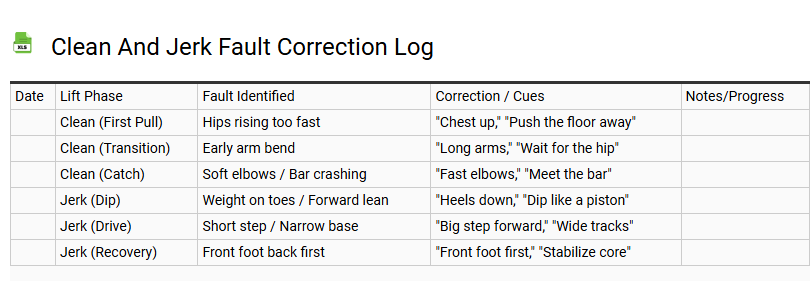
💾 Clean and Jerk Fault Correction Log .xls
A Clean and Jerk Fault Correction Log serves as a vital diagnostic tool for Olympic weightlifters aiming to refine their technical proficiency. By documenting specific movement errors during the first pull, triple extension, and split jerk, athletes can identify recurring patterns in their bar path and catch position. This template facilitates tracking corrective exercises designed to improve elbow turnover, front rack mobility, and footwork stability.
Monitoring variables such as jerk drive mechanics and overhead stability ensures targeted progress in explosive power and strength training cycles. Utilizing a structured log helps minimize lifting faults, optimizes biomechanics, and accelerates the mastery of the clean and jerk sequence. Consistent data entry empowers coaches to adjust programming based on objective performance metrics, leading to safer, more efficient vertical displacement of the barbell during high-intensity training sessions.
Olympic Lifting Mobility and Stability Assessment
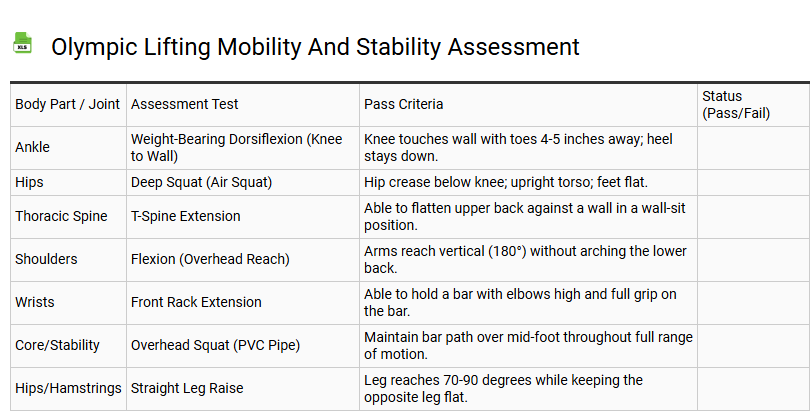
💾 Olympic Lifting Mobility and Stability Assessment .xls
An effective Olympic lifting mobility and stability assessment evaluates the functional readiness of the kinetic chain for the snatch and clean and jerk. This diagnostic template examines ankle dorsiflexion and hip mobility to ensure a vertical torso during the deep squat and catch phase. Assessing thoracic extension and shoulder stability is critical for maintaining a secure overhead position and optimal barbell trajectory. By analyzing joint range of motion alongside neuromuscular control and core bracing, coaches can identify biomechanical limitations that hinder triple extension. This systematic approach prioritizes proprioception and scapular upward rotation, reducing injury risk while improving force production. Utilizing this assessment ensures athletes possess the structural integrity and flexibility required for explosive movements, allowing for seamless transitions between the pull and the receiving position.
Weightlifting Percentages and Repetition Calculator
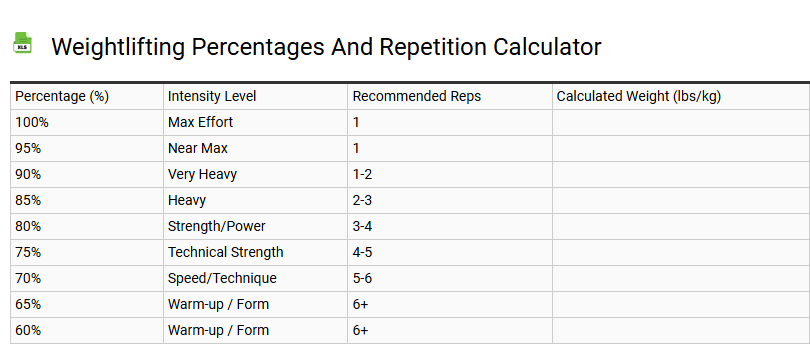
💾 Weightlifting Percentages and Repetition Calculator .xls
This specialized tool serves as a cornerstone for strength training periodization, allowing athletes to derive precise one-repetition maximum (1RM) values. By utilizing validated algorithms like the Epley or Brzycki formula, the calculator translates submaximal efforts into actionable percentage-based training loads. This systematic approach is essential for managing training intensity and volume across various cycles, including hypertrophy, power development, and maximal strength phases.
Integrating this weightlifting template ensures accurate progressive overload by determining the exact barbell weight needed for specific rep ranges. Whether you are focusing on Olympic lifting or powerlifting, understanding the correlation between load and neuromuscular fatigue is vital. Use these calculated metrics to optimize muscle recruitment, prevent overtraining, and ensure every resistance training session aligns perfectly with your performance benchmarks and long-term athletic goals.
Olympic Lifting Competition Readiness Checklist
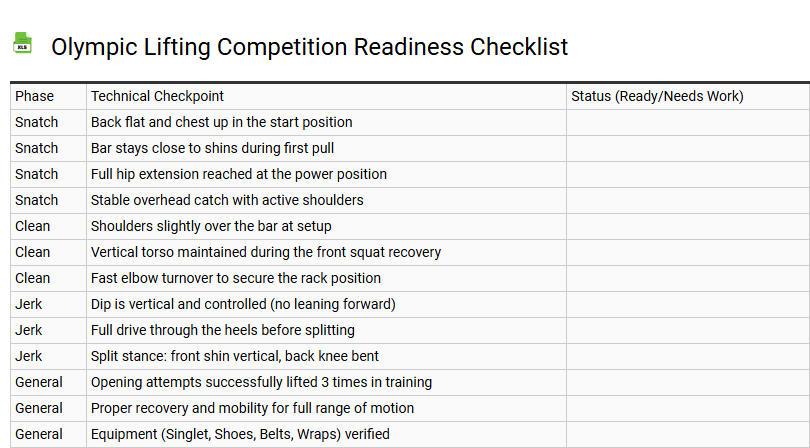
💾 Olympic Lifting Competition Readiness Checklist .xls
Triple Extension Mechanics Audit
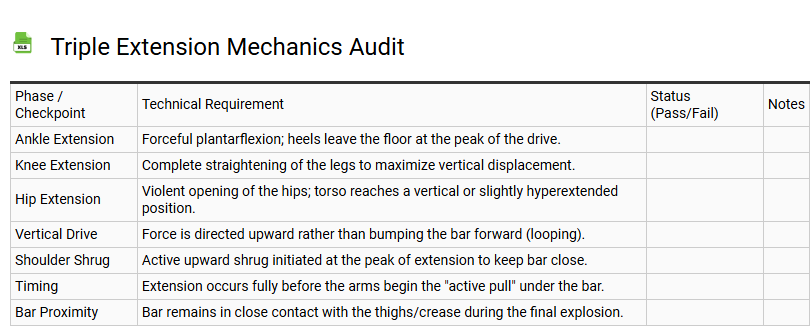
💾 Triple Extension Mechanics Audit .xls
Snatch Turnover and Receiving Position Tracker
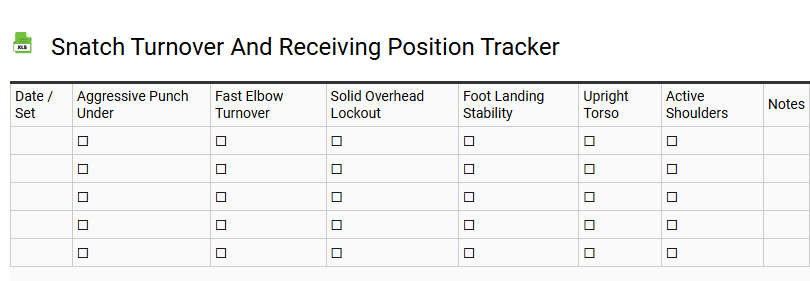
💾 Snatch Turnover and Receiving Position Tracker .xls
This specialized Olympic weightlifting template optimizes your performance by monitoring the critical snatch turnover and receiving position. Precision during the pull under is essential for a seamless catch phase, ensuring the athlete transitions efficiently from the second pull into a stable overhead squat. By documenting barbell velocity and footwork, lifters can refine their technical proficiency and stability within the bottom position.
Effective tracking focuses on key performance indicators including:
- Mobility and shoulder stability during the lockout.
- Consistency of the bar path and depth.
- Balance and core engagement under heavy loads.
Consistent data collection helps identify mechanical flaws, allowing for targeted drills to enhance athletic performance and maximize one-rep max potential through improved power output and kinesthetic awareness.
Clean and Jerk Recovery and Jerk Drive Checklist
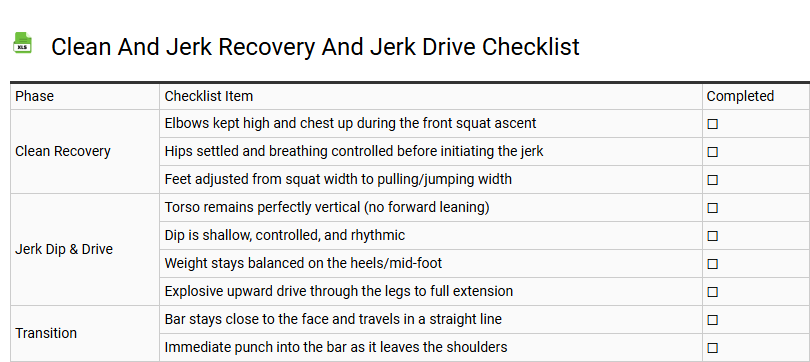
💾 Clean and Jerk Recovery and Jerk Drive Checklist .xls
Mastering the Clean and Jerk recovery and jerk drive requires precise technical execution and overhead stability. Athletes must focus on maintaining a vertical torso during the dip phase to maximize force production through the heels. This checklist ensures optimal kinetic chain alignment for a successful lift:
- Recovery: Stabilize the front squat, keep elbows high in the rack position, and reset breathing before the drive.
- Jerk Drive: Execute a controlled, shallow dip followed by an explosive triple extension to generate vertical impulse.
- Lockout: Punch the barbell aggressively overhead, achieving active shoulders and a rigid elbow lockout.
- Footwork: Ensure a stable split position with the front shin vertical and weight balanced for total barbell control.
Refining these Olympic lifting mechanics improves power output and ensures a legal lift completion during high-intensity weightlifting sessions.
Olympic Lifting Power vs Full Movement Comparison
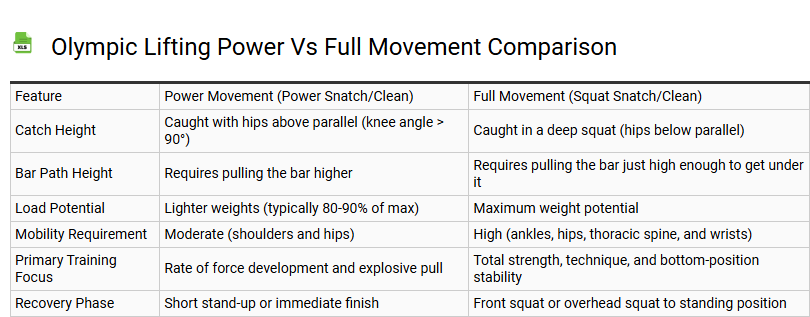
💾 Olympic Lifting Power vs Full Movement Comparison .xls
The primary distinction between power and full Olympic lifts lies in the catch height and receiving position. In a power snatch or power clean, the athlete catches the barbell with thighs above parallel, demanding greater vertical displacement and explosive triple extension. Conversely, full movements require the lifter to drop into a deep front squat or overhead squat, emphasizing mobility, timing, and the ability to move rapidly under the load.
While full lifts allow for maximal weight due to the reduced pull height, power variations prioritize rate of force development and eccentric control. Integrating both styles optimizes neuromuscular adaptation and barbell trajectory. Athletes utilize these variations to refine technical proficiency, enhance kinetic chain coordination, and build foundational strength-speed within the snatch and clean and jerk disciplines.
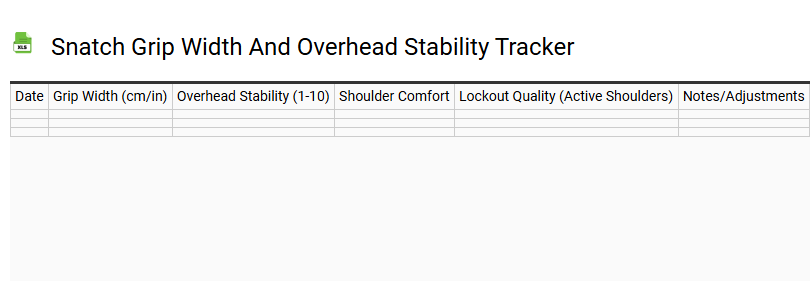
Snatch Grip Width and Overhead Stability Tracker
💾 Snatch Grip Width and Overhead Stability Tracker .xls
This snatch grip width and overhead stability tracker is designed to optimize your Olympic weightlifting performance. By systematically logging hand placement, athletes can pinpoint the ideal barbell positioning within the hip crease, ensuring a more explosive snatch pull. Monitoring these metrics is essential for developing active shoulders and robust scapular stability, which are critical for a secure lockout during the catch phase.
The template tracks progress across key movements like the overhead squat and snatch balance, highlighting correlations between wrist alignment and shoulder mobility. Using this data-driven approach helps minimize technical errors, such as premature arm bend, while maximizing trapezius engagement. Consistently recording your grip width variations allows for fine-tuning your barbell trajectory, leading to a more reliable base of support and improved structural integrity under heavy loads.
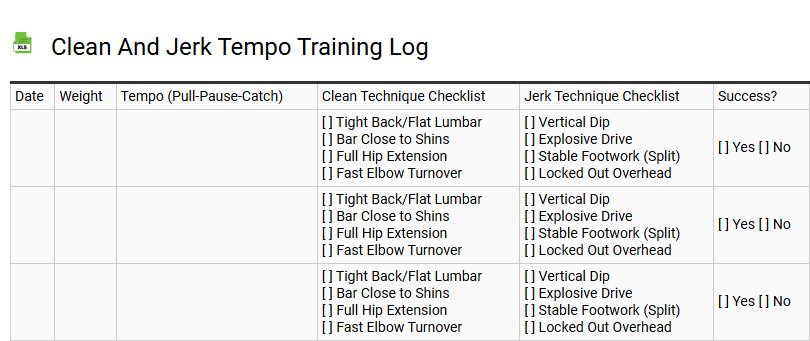
Clean and Jerk Tempo Training Log
💾 Clean and Jerk Tempo Training Log .xls
Optimizing Olympic weightlifting performance requires a structured Clean and Jerk tempo training log to monitor technical precision. By documenting specific tempo counts-including the eccentric phase, isometric pauses, and explosive concentric drive-athletes refine barbell mechanics and positional strength. This template prioritizes time under tension (TUT) during the first pull and transition, ensuring stability in the front rack position and split jerk recovery. Record your lifting volume, relative intensity, and RPE within each session to facilitate progressive overload. Consistently logging barbell velocity and power output helps identify mechanical sticking points in the clean pull or jerk drive. Utilizing this strength program framework enhances neuromuscular adaptation, leading to improved hypertrophy and 1RM efficiency throughout your weightlifting macrocycle. Tracking these variables ensures consistent gains in explosive power and total tonnage.
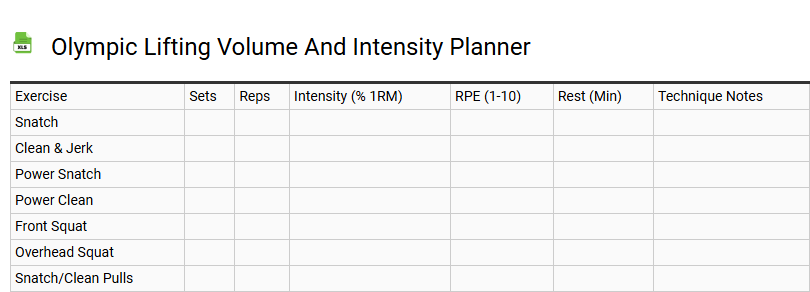
Olympic Lifting Volume and Intensity Planner
💾 Olympic Lifting Volume and Intensity Planner .xls
This Olympic Lifting Volume and Intensity Planner provides a data-driven framework for mastering the snatch and clean and jerk. By integrating periodization principles, the template balances total tonnage with relative intensity to optimize neuromuscular adaptations and technical proficiency.
Utilizing percentage-based training and Prilepin's Chart, the planner helps athletes navigate various strength cycles, including:
- Hypertrophy Phases: High volume with moderate intensity to build foundational muscle.
- Strength Cycles: Increasing load while managing fatigue and recovery.
- Peaking Blocks: Maximizing 1RM potential through high-intensity, low-volume tapering.
The system tracks RPE (Rate of Perceived Exertion) and weekly volume loads, ensuring progressive overload without overtraining. By refining rep ranges and sets, lifters can maintain peak performance, improve lifting mechanics, and hit new personal records through strategic, evidence-based programming.
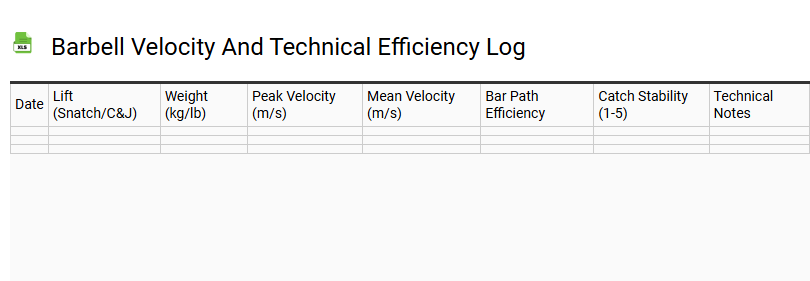
Barbell Velocity and Technical Efficiency Log
💾 Barbell Velocity and Technical Efficiency Log .xls
This integrated template facilitates precise Velocity-Based Training (VBT) by tracking mean concentric velocity and peak velocity in meters per second (m/s). By utilizing a load-velocity profile, athletes can accurately estimate their one-rep max (1RM) and implement autoregulation based on daily readiness.
The log emphasizes technical efficiency by monitoring bar path consistency and force production metrics. Recording velocity loss thresholds allows for the management of neuromuscular fatigue, ensuring every repetition stays within the desired strength-speed or speed-strength zones. Users can correlate Rate of Perceived Exertion (RPE) with linear position transducer data to refine biomechanical efficiency. This structured data entry optimizes power output and explosive strength, bridging the gap between raw intensity and movement quality for superior athletic performance.
This Olympic lifting technique checklist serves as a vital template for mastering the snatch and clean and jerk. By evaluating barbell mechanics, triple extension, and bar path efficiency, athletes enhance explosive power. This systematic guide prioritizes the kinetic chain, ensuring a secure hook grip and stable receiving positions. Integrating this resource into your strength program promotes technical proficiency and reduces injury risk. Consistency in weightlifting form is paramount for peak performance. Use this comprehensive summary to refine every movement and dominate the platform.