
Progressive Overload Log Template for Tracking Strength Training Progress
Optimizing your fitness journey requires a structured progressive overload log to monitor consistent gains. By meticulously tracking strength training metrics like volume, resistance, and repetitions, you ensure steady muscle growth and avoid plateaus. A well-designed workout log facilitates incremental weight increments, driving long-term hypertrophy and athletic performance. Utilizing a systematic approach to record each training session allows for precise adjustments in intensity and recovery. This methodology is essential for anyone serious about maximizing physical potential and achieving measurable results. Explore our diverse selection of professionally designed variations of templates below.
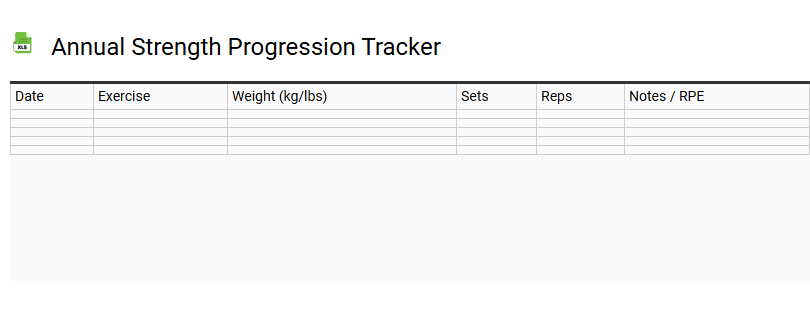
Annual Strength Progression Tracker
💾 Annual Strength Progression Tracker .xls
The Annual Strength Progression Tracker is a specialized tool designed to monitor and analyze long-term athletic development. By systematically recording primary compound lifts-such as the squat, bench press, and deadlift-over a twelve-month period, this template provides a macro-level view of physical evolution and performance trends.
- Progressive Overload Tracking: Logs changes in volume, intensity, and total tonnage to ensure consistent stimulus.
- One-Rep Max (1RM) Estimation: Utilizes standardized formulas to project strength gains without the fatigue of frequent maximal testing.
- Periodization Visualization: Identifies seasonal peaks and plateaus, allowing for data-driven adjustments to training blocks.
By centralizing performance metrics, this tracker transforms raw data into actionable insights. It serves as an essential resource for athletes and coaches aiming to optimize recovery, manage fatigue, and achieve specific strength milestones throughout the calendar year.
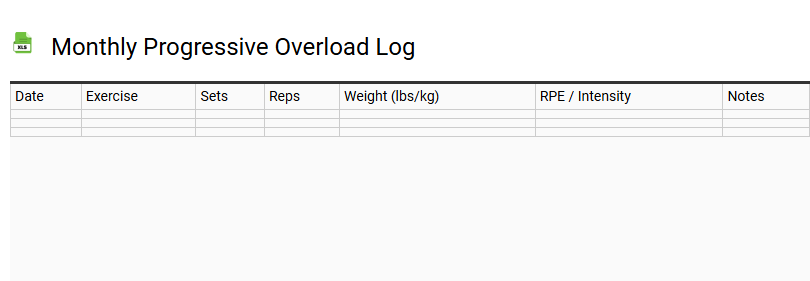
Monthly Progressive Overload Log
💾 Monthly Progressive Overload Log .xls
A monthly progressive overload log serves as a critical instrument for tracking strength gains and driving muscle hypertrophy. By meticulously documenting training volume and intensity, athletes ensure consistent physiological adaptation. This systematic approach necessitates incremental increases in resistance, repetitions, or frequency to challenge the musculoskeletal system effectively.
Utilizing a structured template allows for the visualization of performance trends across compound lifts and isolation movements. Key metrics to monitor include:
- Mechanical tension and total tonnage.
- Rate of Perceived Exertion (RPE) for intensity regulation.
- Rest intervals and set density.
Maintaining this fitness journal prevents plateaus and optimizes metabolic stress. Strategic data entry facilitates informed adjustments to your workout routine, ensuring long-term athletic development and improved body composition through disciplined resistance training.
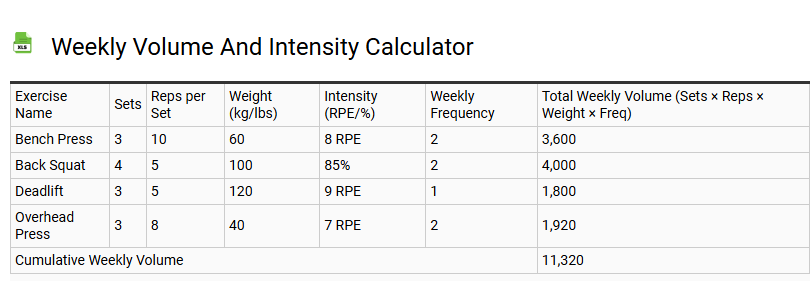
Weekly Volume and Intensity Calculator
💾 Weekly Volume and Intensity Calculator .xls
The Weekly Volume and Intensity Calculator is a specialized tool designed to quantify physical training stress and ensure sustainable athletic progression. This template enables users to input specific data points-such as total sets, repetitions, and load-to derive critical metrics like total tonnage and average relative intensity.
By centralizing these variables, the calculator facilitates progressive overload management, allowing for precise adjustments to prevent plateauing or overtraining. It tracks the distribution of work across the training cycle, offering insights into systemic fatigue and recovery requirements.
Optimized for both strength and hypertrophy phases, this template provides a clear visual representation of workload fluctuations. Utilizing this data-driven framework ensures that every training block is strategically aligned with long-term performance goals, promoting optimal adaptation through disciplined volume tracking and intensity modulation.
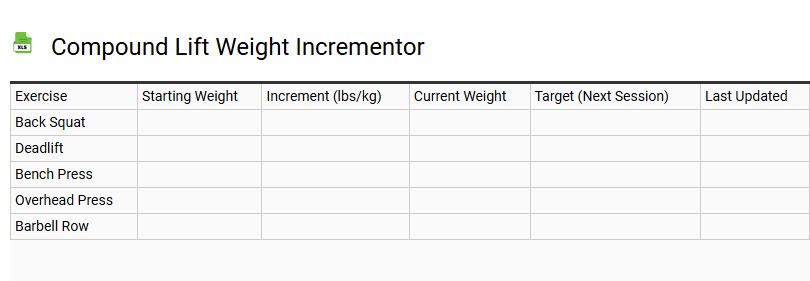
Compound Lift Weight Incrementor
💾 Compound Lift Weight Incrementor .xls
The Compound Lift Weight Incrementor is a strategic tool designed to facilitate progressive overload across foundational movements. By inputting baseline performance metrics for exercises such as the squat, deadlift, and overhead press, this template automates the calculation of systematic load increases for future training cycles.
- Systematic Progression: Applies fixed weight additions or percentage-based increments, typically ranging from 1% to 5% per session.
- Rounding Logic: Features built-in formulas to align calculated weights with standard plate increments, such as 2.5lb or 1.25kg intervals.
- Data-Driven Growth: Provides a clear visual roadmap for strength development, ensuring consistent mechanical tension and adaptation.
Utilizing this structured framework helps athletes avoid training plateaus and manage fatigue. By prioritizing incremental gains over unsustainable spikes in intensity, the incrementor fosters long-term performance milestones and minimizes the risk of injury through controlled, predictable resistance training.
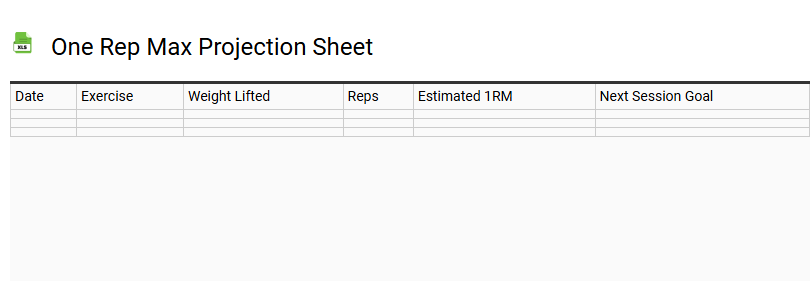
One Rep Max Projection Sheet
💾 One Rep Max Projection Sheet .xls
A One Rep Max Projection Sheet serves as a vital blueprint for structured strength training and effective periodization. By inputting submaximal loads and repetitions, lifters utilize mathematical models like the Brzycki formula or Epley equation to determine an estimated 1RM without the central nervous system fatigue of true maximal testing.
This weightlifting calculator approach allows athletes to define precise intensity zones for resistance training, ensuring every set aligns with specific goals like hypertrophy or peak power. Integrating these projections into your routine facilitates progressive overload and data-driven volume management. Using a standardized template helps track muscular strength gains over time, providing the necessary metrics for powerlifting prep or general fitness. Ultimately, these calculated lifting percentages minimize injury risk while optimizing performance through accurate, evidence-based programming.
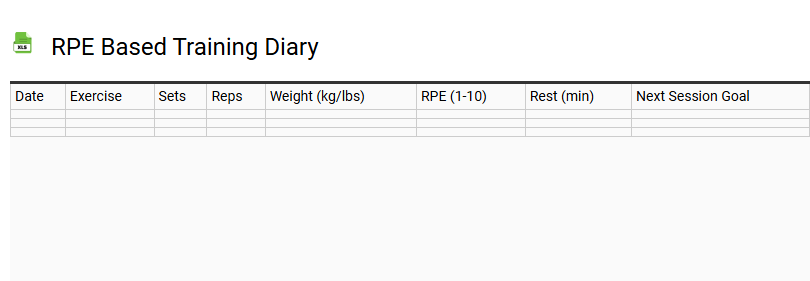
RPE Based Training Diary
💾 RPE Based Training Diary .xls
An RPE based training diary serves as a vital tool for athletes leveraging autoregulation to maximize physical output. By documenting the Rate of Perceived Exertion on a 1–10 scale, this template allows for precise intensity management and fatigue tracking. Unlike rigid percentage-based programs, an RPE lifting log adapts to your daily recovery status and muscular endurance, ensuring progressive overload without the risk of overtraining.
Utilizing a Borg scale approach within your strength programming helps refine subjective intensity, making it easier to monitor training volume and workout performance. This systematic method of recording exertion levels ensures each session aligns with your current physiological readiness. Whether focusing on hypertrophy or powerlifting, maintaining a detailed diary facilitates long-term load progression and injury prevention by auditing real-time work capacity and central nervous system readiness.
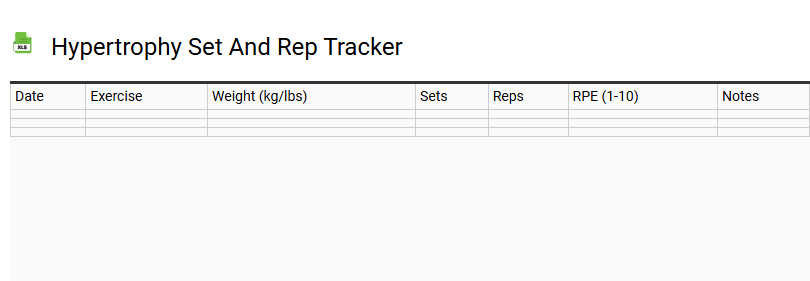
Hypertrophy Set and Rep Tracker
💾 Hypertrophy Set and Rep Tracker .xls
This hypertrophy set and rep tracker is a specialized tool designed to facilitate muscle growth through the principles of progressive overload. By meticulously documenting every resistance training session, users can monitor critical variables such as total volume, mechanical tension, and metabolic stress. This training log focuses on optimizing the rep range and set counts necessary to trigger myofibrillar hypertrophy.
Utilizing a structured fitness template ensures consistent load progression while tracking reps in reserve (RIR) to manage the stimulus-to-fatigue ratio. Whether performing compound movements or isolation exercises, this tracker helps identify plateaus within your hypertrophy cycles. Implementing detailed volume tracking allows for data-driven adjustments to intensity and recovery, ensuring long-term muscle fiber recruitment and peak physical development during every strength training phase.
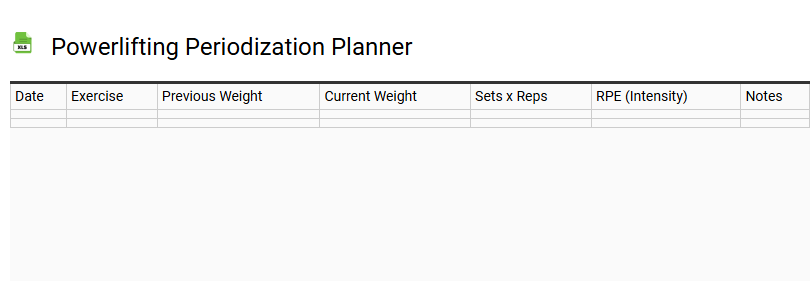
Powerlifting Periodization Planner
💾 Powerlifting Periodization Planner .xls
This comprehensive Powerlifting Periodization Planner serves as a strategic roadmap for athletes aiming to maximize their competition total in the squat, bench press, and deadlift. By utilizing structured mesocycles, this template facilitates a seamless transition through critical training phases, including hypertrophy, general strength, and specialized peaking blocks. Each microcycle is engineered to balance volume and intensity, ensuring consistent progressive overload while managing systemic fatigue via RPE (Rate of Perceived Exertion) and percentage-based loading.
Designed for elite performance, the framework tracks 1RM estimations and workload distribution to mitigate injury risks. Whether you are an intermediate lifter or a competitive powerlifter, this periodized approach optimizes neuromuscular adaptation and technical proficiency. Streamline your programming, monitor recovery, and achieve new personal records with a data-driven strategy tailored for strength development and peak athletic output.
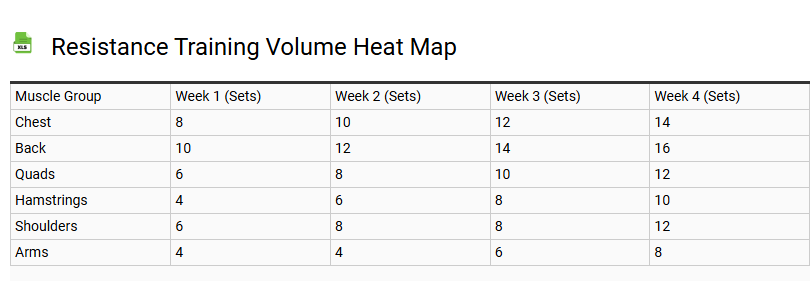
Resistance Training Volume Heat Map
💾 Resistance Training Volume Heat Map .xls
A resistance training volume heat map serves as a sophisticated visual data tool designed to track workload distribution across specific muscle groups. By quantifying weekly sets and intensity, this template enables lifters to optimize hypertrophy and strength development through strategic periodization. The primary objective is to monitor training frequency while identifying potential recovery gaps or overtraining risks.
By analyzing the cumulative training load, athletes can ensure balanced exercise selection and strict adherence to progressive overload principles. Utilizing color-coded gradients helps in fatigue management, allowing for real-time adjustments to your programming. Whether focusing on compound movements or isolation work, this analytical framework provides a clear snapshot of volume distribution, ensuring consistent physiological adaptations and preventing performance plateaus during long-term strength training cycles.
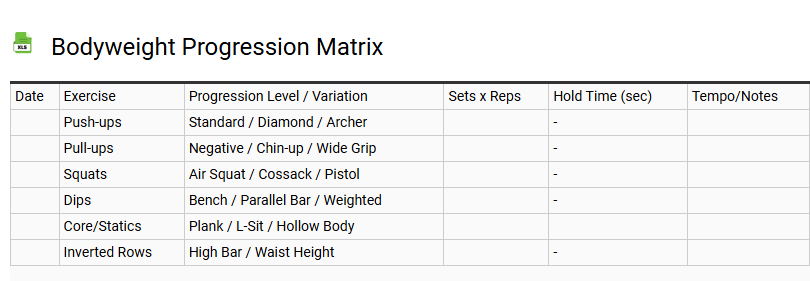
Bodyweight Progression Matrix
💾 Bodyweight Progression Matrix .xls
A Bodyweight Progression Matrix is a strategic framework designed to organize calisthenics exercises by movement patterns and mechanical difficulty. This template categorizes fundamental actions-such as pushing, pulling, core stability, and lower-body movements-into linear tiers of intensity.
By mapping out variations from beginner to elite levels, the matrix facilitates progressive overload without the need for external weights. It focuses on several key developmental pillars:
- Leverage Manipulation: Adjusting body angles to increase resistance.
- Skill Acquisition: Transitioning from foundational holds to complex dynamic movements.
- Systematic Scaling: Providing clear benchmarks for consistent physical advancement.
Utilizing this matrix ensures a logical roadmap for strength and hypertrophy. It allows athletes to identify their current capacity and select the appropriate next step, ensuring that training remains challenging while minimizing the risk of injury through structured adaptation.
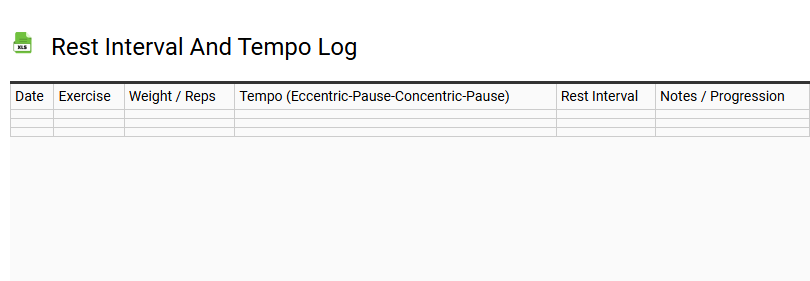
Rest Interval and Tempo Log
💾 Rest Interval and Tempo Log .xls
Utilizing a rest interval and tempo log is essential for athletes prioritizing time under tension (TUT) and precise hypertrophy goals. This tracking template monitors the duration of recovery periods between sets to manage metabolic stress and central nervous system fatigue. By documenting the lifting cadence-specifically the eccentric phase, isometric pause, and explosive concentric contraction-lifters ensure consistent mechanical tension across every rep.
Implementing a structured fitness journal for these variables facilitates progressive overload and prevents training plateaus. Key features of an optimized log include:
- Rest Periods: Balancing ATP-CP recovery for strength gains.
- Tempo Code: Maintaining specific rep speeds for muscle fiber recruitment.
- Volume Tracking: Analyzing the correlation between recovery time and total workload.
This data-driven approach refines periodization strategies, ensuring each resistance training session maximizes physiological adaptations and muscle protein synthesis.
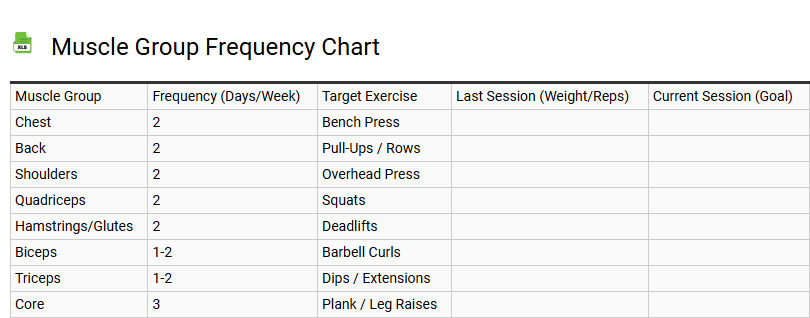
Muscle Group Frequency Chart
💾 Muscle Group Frequency Chart .xls
A muscle group frequency chart serves as a strategic blueprint for optimizing hypertrophy and metabolic recovery. By tracking how often specific tissues like the quadriceps, latissimus dorsi, or pectorals are stimulated, lifters can maximize muscle protein synthesis windows. Most effective split routines prioritize a weekly frequency of two to three sessions per muscle group to balance training volume with systemic fatigue management.
Utilizing this template allows for precise workout programming, ensuring adequate rest intervals to prevent overtraining. By visualizing the distribution of intensity and sets across a microcycle, athletes achieve better physiological adaptation. Whether implementing a full-body approach or a push-pull-legs structure, monitoring frequency is essential for consistent strength gains, balanced muscular development, and long-term injury prevention within any periodized resistance training framework.
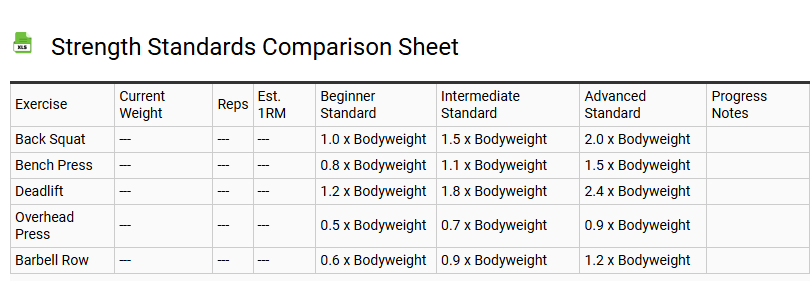
Strength Standards Comparison Sheet
💾 Strength Standards Comparison Sheet .xls
This strength standards comparison sheet serves as a comprehensive benchmarking tool for athletes to evaluate their lifting progress against verified global data. By integrating critical performance metrics such as one-rep max (1RM), bodyweight ratios, and relative strength indices, lifters can accurately categorize their capabilities across tiers ranging from novice to elite.
The template optimizes the tracking of progressive overload and absolute strength for core compound movements. Key features include:
- Weight class specific benchmarks for competitive powerlifting.
- Strength-to-weight ratio calculations to assess functional efficiency.
- Comparison of Wilks scores or Sinclair coefficients for normalized scoring.
- Demographic-adjusted performance metrics based on age and gender.
Utilizing this structured data ensures objective assessment of physical development, helping lifters identify structural imbalances and refine their hypertrophy or peak strength programming.
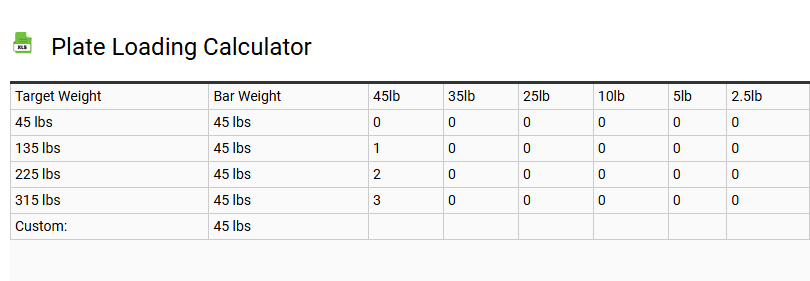
Plate Loading Calculator
💾 Plate Loading Calculator .xls
A plate loading calculator is a specialized utility designed for strength athletes and powerlifters to determine the exact distribution of weight plates required to reach a specific target mass. By inputting the total goal weight and the barbell's mass, the tool eliminates manual calculation errors and ensures a balanced load on both sides of the sleeve.
- Inventory Customization: Users can toggle available plate denominations, including standard 45lb/20kg plates and smaller fractional weights.
- Visual Breakdown: The interface typically provides a clear, sequential list of plates to be loaded per side.
- Efficiency: Streamlines transitions between training sets by providing instant loading sequences.
This template serves as a functional framework for developers to build responsive weightlifting tools that prioritize accuracy, safety, and user experience in high-intensity training environments.
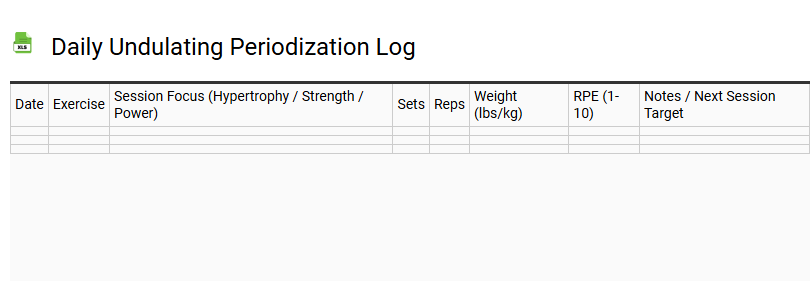
Daily Undulating Periodization Log
💾 Daily Undulating Periodization Log .xls
A Daily Undulating Periodization (DUP) log serves as a high-level tracking tool for athletes focusing on strength training and hypertrophy. Unlike traditional linear models, this periodization strategy rotates intensity and volume within a single microcycle. By systematically recording compound lifts, lifters can better manage neuromuscular adaptation and systemic fatigue.
The template facilitates the daily rotation of hypertrophy blocks, power sessions, and strength sets. Essential data points include RPE (Rate of Perceived Exertion), total volume load, and specific rep schemes. Utilizing a structured log ensures consistent progressive overload while minimizing plateaus. Monitoring these variables allows for precise adjustments to training frequency and recovery protocols, ultimately maximizing muscle protein synthesis and absolute force production through varied repetition ranges and calculated one-rep max percentages.
This progressive overload log serves as a vital framework for achieving consistent hypertrophy and strength gains. By meticulously tracking volume, intensity, and resistance training metrics, this template ensures measurable improvements in every session. Monitoring reps and sets within a dedicated fitness journal allows athletes to visualize performance trends and ensure muscle growth. Implementing this systematic approach to weightlifting data is essential for long-term success. Start documenting your journey today to maximize physical output through disciplined, data-driven strength training adjustments.